
Williams
 This story started with my visit to Henry Grainger, Crimean War veteran’s, gravesite – in the Old Pioneer Cemetery off Albany Highway. Williams has three cemeteries and at least two lonely gravesites. Pictured is the current Williams Cemetery opened in 1914; the Marling (Boraning) Cemetery originally owned by the Cowcher family 26 kms. from Williams; the Old Pioneer Cemetery on land donated by the Hamersley family in the 1870s; the lonely graves of Anna Maria Grainger and her daughter Mary Ann, buried in c.1869 at Carter’s Crossing on the Williams-Kondinning Road. Not pictured is the gravesite of David Grainger 51st Regiment settler and others, at Beaufort Bridge, on the Perth-Albany Road.
Early Explorations
Williams belongs to the Gnaala Karla Boodja region, referring to the Noongar language or dialectical groups of the BinJarab/Pinjarup, Wilman and Ganeang. The Williams District was first explored in 1831, when Captain Thomas Bannister led the first overland expedition from the Swan River Colony to King George Sound (Albany). During this expedition, they discovered a River flowing through their route and named it Williams River. The first land claims in the area occurred in 1832. In 1835, an expedition led by Governor James Stirling and John Septimus Roe surveyed a route joining King George Sound with York via Williams to encourage inland settlement [extract Shire of Williams history webpage].

Meanwhile in September 1833, the 21st Regiment (Royal North British Fuzileers) had arrived on the ship Jane from Hobart, Van Diemen’s Land. On board were Captains John Picton Beete and Richard Daniell, Assistant Surgeon James Davidson, four lieutenants, four sergeants and 119 rank and file; a total of 130 men. There would be other ships with arrivals of the 21st Regiment within the next seven years: Caroline, Sir John Rae Reid and Maria.
Lieutenant Henry William St Pierre Bunbury arrived in Fremantle on the ship Maria from Launceston to join his regiment – the 21st. His first War Office paylist record in the Colony indicated that he had been serving in Hobart Town and arrived on 28th March 1836 along with his servant, Private #447 James Hertnan [Perth Gazette]. Within a month Lt. Bunbury’s diary records, I am going down with ten men to assist in establishing a settlement in a country which has only been visited by White Men during the last year and of which scarcely anything is known; but two adventurous Settlers are going to establish themselves on the banks of the ‘Williams’ river and my party go down for their protection against the natives of whom we know nothing as yet [Bunbury:26].
Bunbury wasted no time and on Thursday 12th May 1836 he started out from James Solomon’s farm located about 11 km west-north-west of what is now the town of Beverley. In his party were Joseph Strelley Harris, John Randall Phillips and ten unnamed soldiers of the 21st Regiment. The route was southwards, following the Dale River upstream, crossing the Hotham River, then south-west towards the site of what is now the town of Bannister and the upper tributaries of the Williams River. The finish place after approximately three weeks was the Dale River in early June. Bunbury records his experiences on this expedition including, at the end, comments about the natives of the Williams River district. His report was addressed to the Colonial Secretary on 15th June 1836. It seems that Harris left the party a day after the start and struck out on a different route of his choosing. This divided the military escort into two groups with four soldiers and a sergeant accompanying Harris – either Philip Baker or Roger Gueran [WO12-3805-155], while Bunbury and five other unnamed soldiers were detailed to escort Phillips [WA Exploration: 21/28].
On 10th July 1836, from York, Bunbury wrote to his family that he expected to make a long journey towards King George’s Sound to open a communication with a military station about to be formed on a river not far from there. He wrote, Even before I started to form the settlement he [Governor Stirling] wrote to the other Colonies that the communication was already opened, that stations were formed and that settlers were about to locate themselves on the excellent land at the Williams. He has found himself woefully deceived. I passed through a wretched country with neither water nor feed: on the Williams the land is generally very bad and the water brackish. Great difficulty was experienced in getting down any provisions for the troops and, as the winter was setting in, the country would soon become impassable for carts. The soldiers have been withdrawn and the only settler who went down is nearly ruined; his stores are in one place, his cart left in another, and those that remain alive of his team of bullocks are unable to move. Such has been the result of the Governor’s wonderful settlement at the Williams which has engrossed the whole attention of the Colony for the last year, and it is only what might have been expected from the hurried and imperfect arrangements. The season was the worst that could have been chosen, when there was neither water nor grass for the cattle, and no sufficient means were forthcoming of sending down stores or provisions. I think I shall go down again to explore in September and make my way to the Sound if possible [Bunbury:29/30].
Bunbury did indeed return to the Williams, in October 1836. His journey from Perth was with the Governor on 15th October. At what point they parted company is not mentioned but Bunbury indicates he crossed the Murray at Pinjarra on foot and that on 23rd he reached the Williams River after being soaked day and night. He records in his personal writings, Numerous painful boils, however, broke out all over my legs which laid me up for three days at the Williams [Bunbury:128]. Bunbury also wrote a report for the expedition he undertook identified as Navarine Brook to Joseph Strelley Harris’s farm over the same period: 20th to 24th October 1836 [WA Exploration:46/51]. Apart from the dates, there isn’t too much similarity between his personal and his official report!
Warriup
About the same time as Bunbury completed his first three-week trip (May/June 1836) with J R Phillips and soldiers from the 21st Regiment, Surveyor Alfred Hillman started his journey to mark the road from Albany also with assistance from the 21st troops.
It had become a matter of urgency that a road from Albany (KGS) to Perth be continued from the start made by the 63rd Regiment in the early 1830’s. Another military outpost was required to see this work through at a spot about halfway between Albany and the Williams River at Warriup. With him were 2nd Lieutenant Armstrong and at least four soldiers of the 21st Regiment. Lieutenant Charles Frederick Armstrong had been promoted on 2 Mar 1832 – the same day as his brother was appointed Captain in the 21st; William Henry Armstrong arrived in the Colony in 1835 on Sir John Rae Reid.
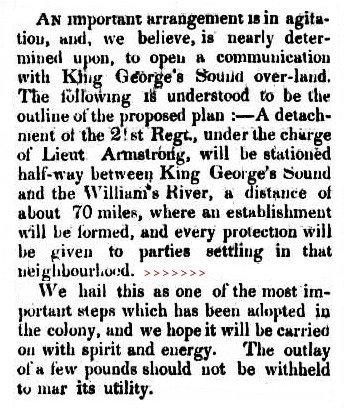
On this trip, Hillman and Armstrong continued the exploration to Warriup on a round-trip expedition to mark out the road about 75 miles from Albany in about 13 weeks from 30th June to 1st October 1836 [WA Exploration:37]. Armstrong’s record in the paylist for this period records only that he was ‘on detachment’, but clearly not sitting about in HQ Perth*. Almost two months before Hillman set out, the Perth Gazette jumped the gun on the proposal. The image (left) has been edited to show some introductory remarks and the optimistic final observation.
*During the trip Armstrong spent six weeks returning to Albany to secure a horse, and another break of ten days to reprovision the party.
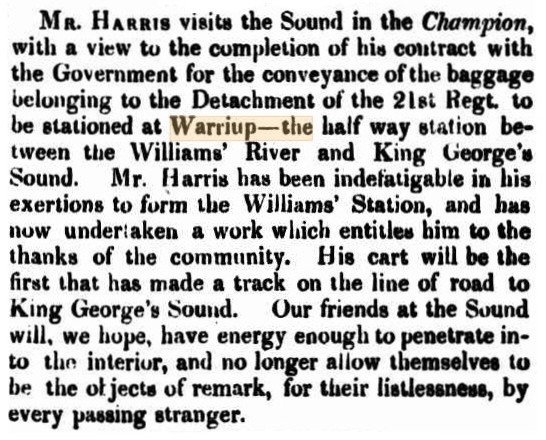
There would be more journeys along the proposed road from King George’s Sound to Perth. Alfred Hillman, the leader and Dr Joseph Harris joined forces to establish the new military post at Warriup. Mr Joseph Strelley Harris had a government carting contract and was responsible for conveying the baggage of a detachment of 21st soldiers to Warriup from KGS. The 18-day journey started in Albany on 21st February 1837 and finished at the Swan River. This was a short, but well manned, journey with Dr Joseph Harris, Dr Thomas Harrison for a brief part of the journey, Mr Patrick Taylor from Albany, Armstrong and eight of his soldiers ‘on detachment’, a native guide, and two cart drivers with the military baggage.
Dr Joseph Harris who arrived in the Colony in January 1833 with his family was a diarist on this expedition as well as Assistant Surveyor Alfred Hilton. Both recorded, when they reached Kojonup and its spring on 28th February, that it had a good potential as a military station. By then it had seemed unlikely that Warriup would have enough water to sustain a military post. Indeed the monthly returns do not mention Warriup when they were first published in September 1837 and Kojonup’s first military detachment begins in October 1837 thus obviating the requirement of a Warriup station [WA Exploration:66/78].
Who Was Where?
The 21st Regiment muster and paylist for February 1837 indicates that 24 men were in Perth HQ, three were sick or in hospital and one in the cells – leaving a balance of approximately 130 troops ‘on detachment’ without a single location recorded for any of them [WO12-3805 folios 227-234].
Barracks – a ‘Bunbury Blueprint’
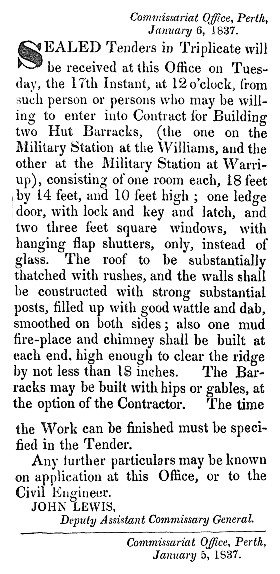
Despite this advertisement in the Perth Gazette (left), let us discount Warriup as a contender for the site of a permanent military post, and put it down to another of Governor Stirling’s fanciful ideas which, fortunately led to a the formation of the Kojonup site which we can still see today.
Lieutenant Bunbury had also spent three months at Wonnerup (near Bunbury), per the Governor’s instructions, to establish a barracks there and used the time to work out a plan for building temporary barracks. This was repeated by Lieutenant Bunbury at Vasse. He records, Our bush method of building is very simple and expeditious, if one can get either rushes or grass tree tops for thatch; we form what are colonially termed ‘V’ huts, but they are rather V reversed or ‘A’ huts. First we cut two strong poles with a fork at one extremity for the ends – the length depending on the height we require-which are placed from 12 to 16 feet apart, a long ridge pole resting in the forks; other poles are placed sloping against the ridge pole with one end nailed or tied to it with rope yarn and the other end buried in the ground; rough wattles as battens are then tied or nailed lengthwise across these poles or rafters and the whole thatched over; and the back is then fitted up with rushes, and part of the front, leaving a gap to serve as door and window and to admit the warmth of the fire blazing outside. Round the fire congregate the Kangaroo dogs and such Natives as may be with one ; it also serves for cooking and boiling the kettle. The battens inside are extremely useful to stick one’s tools, tobacco pipes, dressing things etc in between; a hammock slung across forms one’s bed and the rest of one’s furniture is but scanty:-one or two camp stools, a portable table (or in lieu thereof the tailboard of a cart or any rough plank answers the purpose) supported on four stakes driven into the ground, a small canteen, and a trunk of clothes; complete one’s equipment for the bush, besides the necessary supply of stores… My servant [James Hertnan] had also a little hut built in rear of mine for a kitchen to which we added a stone chimney which answered very well. Thus I was gradually improving on the original plan… Two days were amply sufficient for the erection of a V hut, even where, as at Wonnerup, we had difficulty in finding straight poles to suit as rafters. [Bunbury:122/123].
Now we know how the buildings at the Williams’ barracks might look – perhaps with an upgrade from a contractor. The tricky bit is, where and when would this be? The War Office monthly returns and musters identified the Williams district’s military location as ‘Williams’ from September 1837 and ‘Williamsburgh’ from April 1839 to June 1847. Plans have indicated that these names have also been applied to one of two settlement locations.
Barracks on the Ground
Surveyors and draughtsmen would have a personal set of tools of their trade, but materials such as good paper, inks and printing equipment would be hard to come by in the early years of the Colony and original plans were over-written again and again. Sometimes the additions and dates on plans are explained on a blank area of the plan not filled with anything else. In some of these examples the original was drawn in the 1840’s and edited up until the 1880’s.
Two settlements, presumably with barracks close by, had been envisaged: One at Bannister near the Kondenning Katta; the other called Williamsburgh, on the lower river past where the Boraning Bridge stood. I was able to identify both sites on early survey plans.
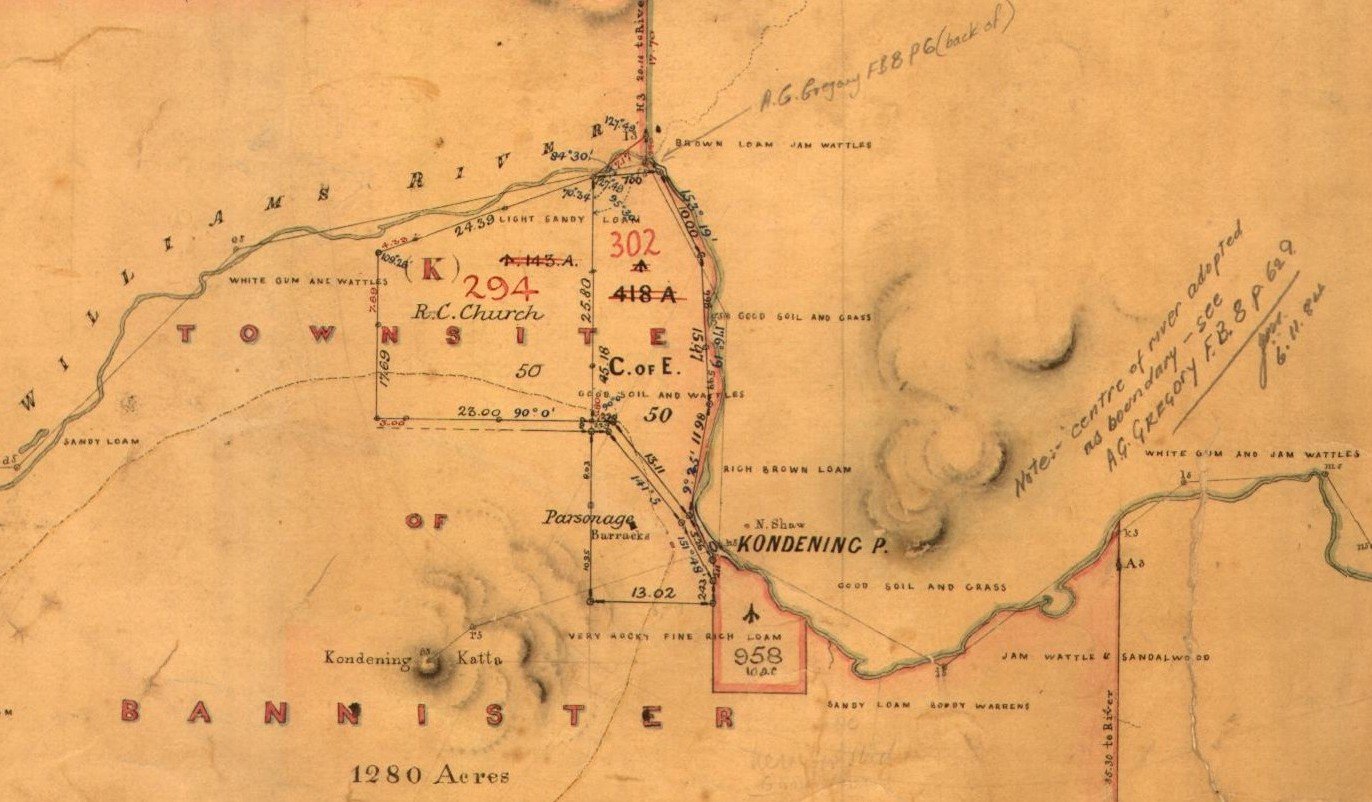
Series S236 Cons 3869 Item 030.
Locations Williams River as marked on the ground by A C Gregory Assistant Surveyor, Sheet 1, 1845 [Plan Description].
Townsite of Bannister, Reserve 143A, etc. (Sheet 1) by A.C. Gregory, and later additions [WASRO Catalogue Description].
Excursion by Lieutenant Henry W Bunbury 12th May to 2nd June 1836 (approx.) See above and WA Exploration:21/28.
The complete plan shows Crown Grant “l” granted to John Randall Phillips of 2000 acres (across the river to the northeast of the townsite) and Crown Grant “K” 1280 acres marked with the word ‘barracks’. In time, Grant “K” would see a portion of land marked for the Roman Catholic Church of 50 acres, surveyed in 1878 by R C Ranford. In equal measure he surveyed 50 acres for the Church of England in 1881. Rev Joseph Withers, Colonial Chaplin in Bunbury, lived in Bannister from 1886 and built ‘The Parsonage’ on Crown Grant “K” on the Church of England’s 50 acres in front of the barracks site.
Series S236 Cons 3869 item 026
Locations in the Williams District Reduced from the Original Survey of A C Gregory Assistant Surveyor 1844-5 [Plan Description].
Saddleback townsite of Williamsburgh & Bannister by A.C. Gregory [WASRO Catalogue Description].
Note: another larger plan of Williams Townsite (i.e. not named Williamsburgh) is available on Cons 3869 Item 029 but includes much later additions up to 1878. If plans for Items 027 and 028 in the Series S236, Cons 3869 survived, I have not found them.
The complete plan (Item 026) shows H Bull’s Crown Grant “A” of 7500 acres north of the townsite. Several grants to the east of the plan show J Strelley Harris’s Crown Grant “N” of 2080 acres on the riverfront, and then a series of four Crown Grants “R” “Q”, “P” “E” for M MacDermott all of 4574 acres, some marked as subdivided. Once again all these plans bear little resemblance to the original of surveyor Gregory. The Barracks is not shown.
Counting Heads
Definitive records of the names and numbers of troops on these jaunts are difficult to come by – for a number of reasons.
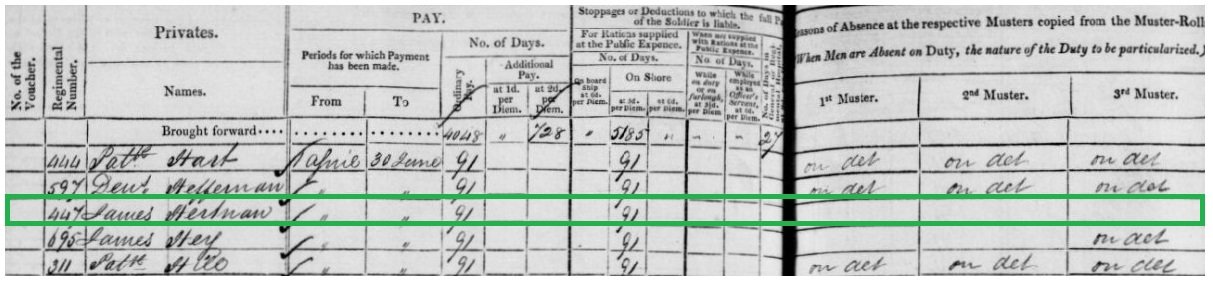
Firstly, the musters and paylists for the 21st Regiment from its arrival in 1833 do not record the location of individual soldiers, only the words ‘on det’[detachment]. Thus for the period mentioned above, 12th May to 2nd June 1836, an example would appear as below, i.e. WO12-3805 folio 161 showing the 2nd and 3rd muster for May and June 1836. The words ‘on det’ or blanks (meaning in Perth HQ) can be seen. Any of the soldiers ‘on det’ could be the five of those exploring the Dale and Williams Rivers. In the example Bunbury’s servant (James Hertnan) is at Perth HQ. Bunbury himself is recorded on folio 153 on detachment – but not where.
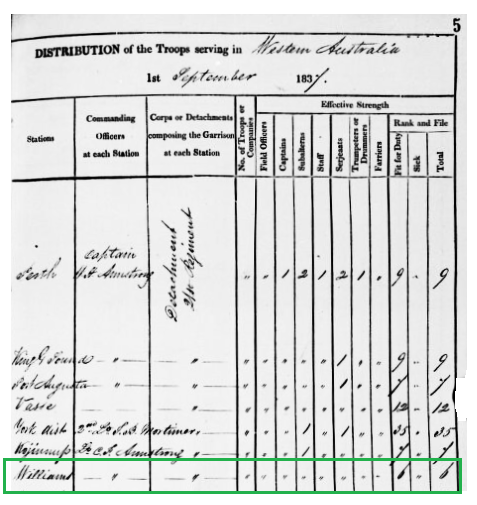 Secondly, the monthly returns for the distribution of troops do not begin until September 1837 i.e. WO17-1234 folio 5. In this particular record we do not know if the six troops match the musters because 21st records only show the comment ‘on det’. However, more often than not the two records do not reconcile. Williams is recorded as the name of the military post in September 1837 (left) to April 1839 when it changed to Williamsburgh until the post was closed in 1847.
Thirdly, the Commandant of Troops General Orders are not available until April 1842 – thus we completely miss out on decisions made at Perth HQ relating to the 21st Regiment and almost two years of the 51st Regiment, commencing with General Order No. 1 in WO28-266 folio 1 on 1st April 1842.
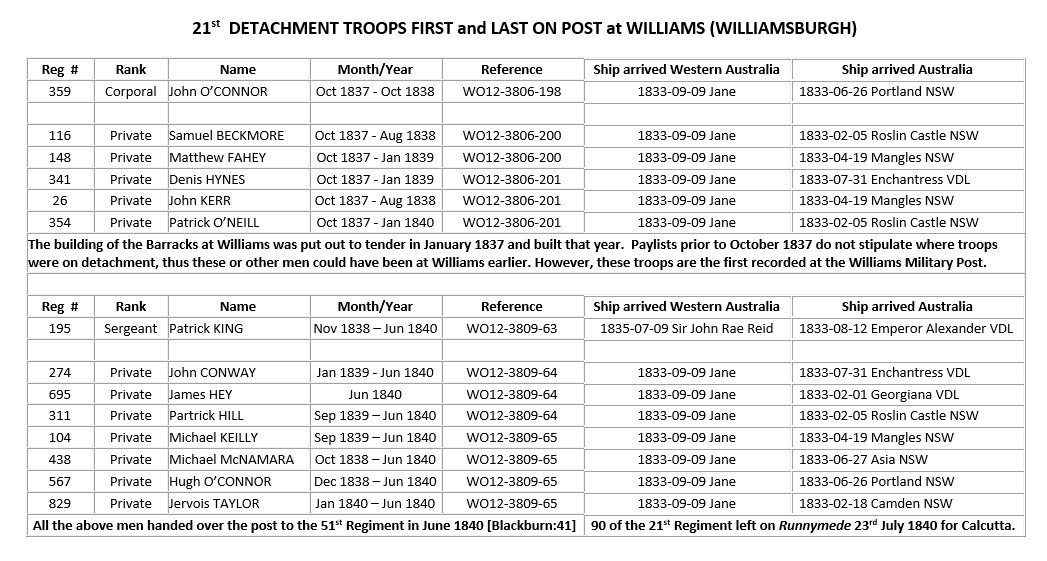
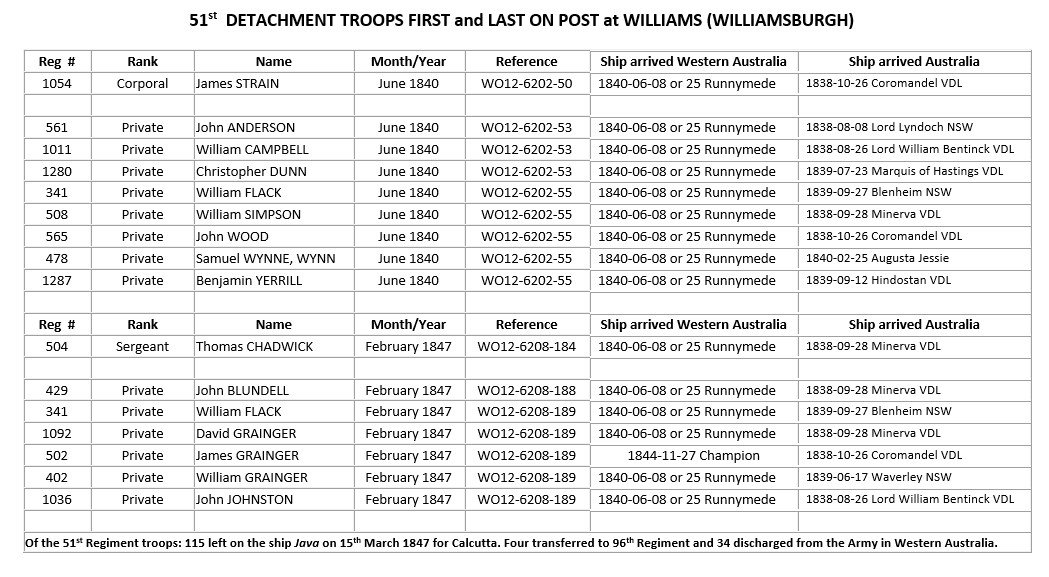
Names from the 21st Regiment who had an association with Williams: John Allison, Philip Baker, Roger Gueran, John Gill, James Hertnan, Malachi Hogan, Michael Quinn and John Thompson, appear in other documents. 51st troops detached to the Williams station throughout its operation were Charles Horn, Thomas Longworth, James Ingersole, William Lewis and Richard Seaton. All of these soldiers took their Army discharges and settled in Western Australia.
First and Last on Post
A Change of Location
John Randall Phillips was Government Resident of the Williams district in 1838/39 but then left for Albany. With no settlers’ interests to look after, the military post was closed on 1st April 1839 and moved from Bannister to Williamsburgh. The Monthly Returns show the change from ‘Williams’ to ‘Williamsburgh’. The name Bannister was never recorded in the returns from September 1837 to 1st April 1839.
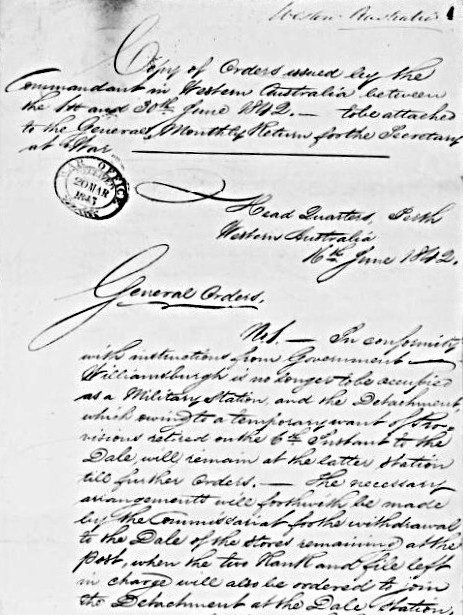 Copy of Orders issued by the Commandant in Western Australia between the 1st and 30th June 1842. – to be attached to the General Monthly Return for the Secretary of War. Head Quarters, Perth, Western Australia. 16th June 1842.
General Orders [Commandant Irwin]
No. 1 – In conformity with instructions from Government – Williamsburgh is no longer to be occupied as a Military Station, and the Detachment, which owing to a temporary want of Provisions retired on the 6th Instant to the Dale, will remain at the latter station till further Orders. – The necessary arrangements will forthwith be made by the Commissariat for the withdrawal to the Dale of the stores remaining at the post, when the two Rank and file left in charge will also be ordered to join the Detachment at the Dale Station. [WO28-266-4].
This order (copy left) seems never to have been implemented. The relevant number of men at the Williamsburgh station from June through to December 1842 and beyond, is consistent at an average of eight rank and file [WO17-1238 folios 44 to 115].
Spikes in the Distribution of Troops
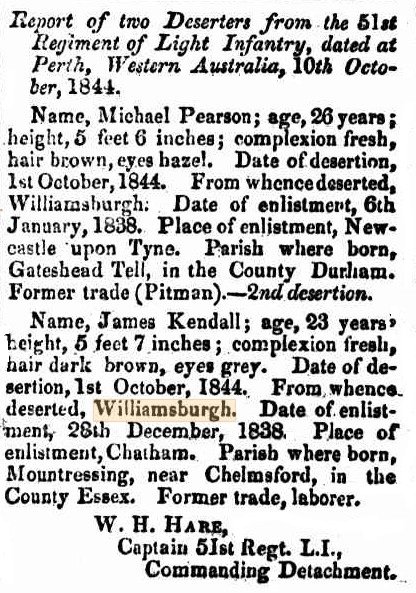
The Monthly Returns’ distribution of troops from 21st and 51st Regiment at Williams (Bannister) and Williamsburgh military posts in records from September 1837 indicate numbers from six to nine rank and file, with eight being a reasonable average. In January 1839 to July 1840, a sergeant arrived on the scene – I am assuming that this occurred to supervise the move from Bannister to Williamsburgh and the change-over when the 51st relieved the 21st in the Colony. Numbers returned to the previous average of eight rank and file for about three years until a sudden spike occurred in numbers during 1844 with the addition of Sergeant John Shepherd and ten rank and file. Among them were David and William Grainger. James Grainger arrived on Champion in November 1844, but he was detached to Perth HQ followed by York upon arrival. In January 1845 an officer, Ensign William J Pegus, was posted to Williams, along with Sergeant Shepherd, and most of that year the rank and file continued to number ten. By December all three Grainger brothers were together in Williamsburgh barracks.
I can see no obvious reason for this spike – the newspapers reported classified advertisements for contracts to feed the soldiers of course, but I can find no other incidents which would cause this increase in troops. Two soldiers deserted and the newspaper carried articles about how the public should be aware; I cannot see how this situation would require additional troops.
Williamsburgh closed as a military post in February 1847 when the 51st left for India in March 1847. Half of the remaining rank and file at that time were the Grainger brothers.
The Graingers
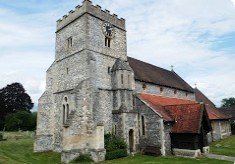
Joseph Granger (sic) and Sarah (nee Townsend) were married in St Mary’s Parish Church, Streatley, Berkshire, England. Their children were baptised in the same church. No birthdates are given as civil registration did not commence in England and Wales until July 1837. All of the Grainger men in Western Australia had Army records and thus I can give an accounting of them. Henry Grainger, his wife, sons Charles and Joseph, and his young daughter are given considerable attention in local histories and for that reason, and his brothers’ army service in Williams, they are mentioned here. A John Grainger who was born in Streatley in 1805, father Steven, was in the 69th Regiment of Foot until his discharge in Ireland in 1844. He had served in the East and West Indies and drew his pension in London. He could have been an uncle or cousin of the Williams’ Graingers, but did not come to WA as far as I can tell.
The only records of a John Grainger I can find in the Colony was a servant who accompanied Thomas Bannister on the ship Atwick arriving in WA in 1829. He was born in Steyning, Sussex and had no connection with the Graingers in Williams. He died in 1879 aged 77, the only man of that name whose death was registered in WA civil death registrations in the 19th century.
Acknowledgements
Deborah Martin, Executive Assistant, Shire of Williams, who patiently answered many of my questions and promptly sent me the book by H G Cowin on The Williams’ history.
Sheryl Milentis and Peter Bridge at Hesperian Press. Sheryl suggested that I borrow an interlibrary loan copy of Western Australian Exploration 1836-1845. Once seen, I definitely wanted ownership of this beautifully designed and informative volume; Peter quickly executed the process.
Wendy Durant, Curator of Rockingham Museum who liberally and frequently loans me books from the Museum’s library of Western Australian history that I often have trouble sourcing anywhere else.
Damien Hassan, Senior Archivist, State Records Office, who gave me links to plans and resources without hesitation and – as is his usual habit – very quickly.
Sources and Bibliography
Books, Journals and Websites
The Military Establishment in Western Australia 1829-1863, E S W & C G S Whiteley, Hesperian Press 2010.
Conquest and Settlement – the 21st Regiment in Western Australia 1833-1840, Geoff Blackburn, Hesperian Press 1999.
Early Days in Western Australia, Letters and Journal of Lieut. H W Bunbury, Oxford University Press 1930.
Western Australian Exploration 1836-1845: letters, reports and journals, ed. Marion Hercock and Sheryl Milentis
with Phil Bianchi, Hesperian Press 2011.
Original Williams Cemetery, Place No. 16095, inHerit, Heritage Council of WA website.
Marling (Boraning) Cemetery, Place No. 16194, inHerit, Heritage Council of WA website.
Old Bannister Town Military Barracks Site, Place No. 16308 , inHerit, Heritage Council of WA website.
Graingers’ Graves, Carters Crossing, Place No. 16311, inHerit, Heritage Council of WA website.
Beaufort Bridge Graves, Place No. 17117, inHerit, Heritage Council of WA website.
Lonely Graves of Western Australia & Burials at Sea, Yvonne & Kevin Coate, Hesperian Press 1986.
Wollaston’s Picton Journal, Volume 1, ed. Canon A Burton & Rev Percy U Henn, Lamb Paterson Pty Ltd.
The Way Through, the story of Narrogin, O E Puskuchen, Artlook Books 1981.
First the Spring, a History of the Shire of Kojonup, Western Australia, Merle Bignell, UWA Press 1982.
The Williams, A H Chate, Early Days, Journal and Proceedings Vol. IV, Part V, RWAHS, Perth 1953.
The Williams, Hurtle G Cowin, printed by The environmental Printing Company, Malaga, WA 1971.
The Shire of Williams History webpage.
Dictionary of Western Australians, Vol. 1 Early Settlers 1829-1850, Pamela Statham, UWA Press 1979.
The Bicentennial Dictionary of Western Australians pre-1829-1888, Vols. I-IV, Rica Erickson, UWA Press, 1987.
Archives
Plan of Townsite of Bannister by A C Gregory 1845, Series S236 Cons 3869 Item 030, WA State Record Office.
Plan of Townsite of Williamsburgh by A Gregory 1844-5, Series S236 Cons 3869 Item 026, WA State Record Office.
War Office Musters & Paylists WO12-3802-3809; 6202-6208, The National Archives, Kew.
War Office Monthly Returns WO17-1234 (1837) to 1248 (1852), The National Archives, Kew.
War Office General Orders HQ WO28-266 Western Australia, 1842 – 1853, The National Archives, Kew.
Newspapers and Gazettes
Perth Gazette 2 Apr 1836 – arrival of Ensign Bunbury and Private Hertnan from Launceston.
Perth Gazette 7 May 1836 – a military post halfway between King George’s Sound and Williams River.
Government Gazette 7 Jan 1837 – tender erection of huts at Williams and Warriup for barracks.
Perth Gazette 11 Feb 1837 – troops intended for Warrigup Military Post.
Perth Gazette 10 Oct 1844 – deserters from the 51st Regiment at Williamsburgh.
Illustrations
Colonel H W Bunbury in later life [Early Days in Western Australia, Oxford University Press 1930].
Mary’s Parish Church, Streatley, Berkshire [National Churches Trust, Registered Charity No. 1119845].
© Diane Oldman 2025