
Earl St Vincent 1826
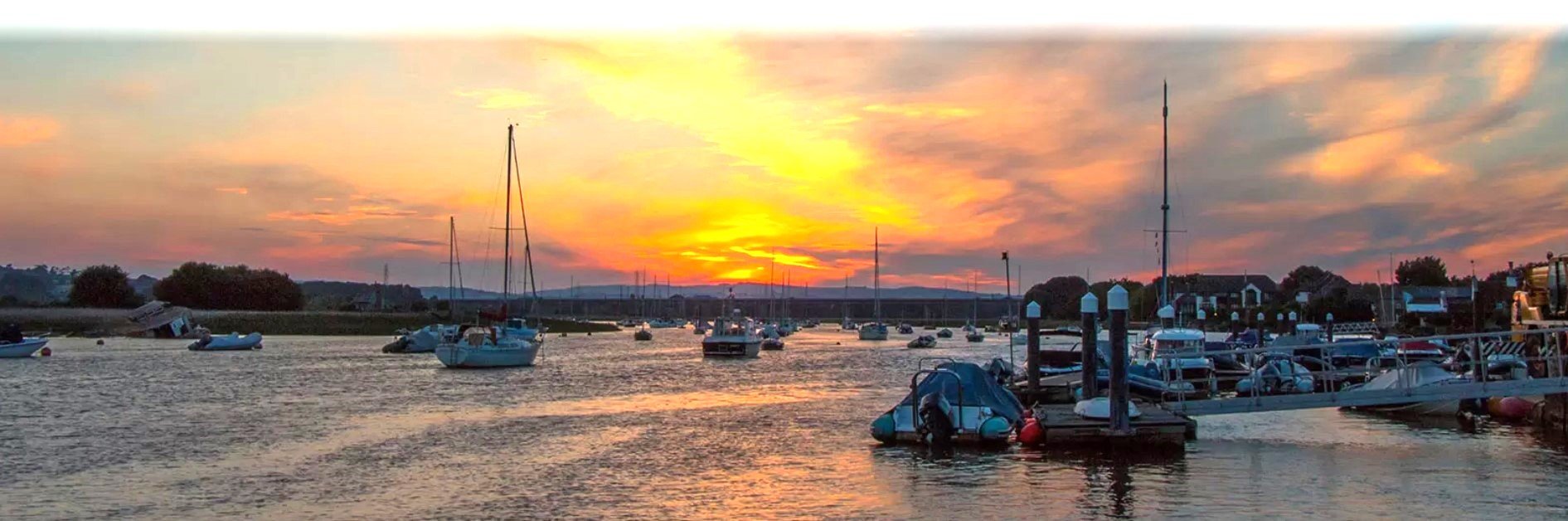
Topsham, Devon on the east bank of the River Exe. Over 200 years ago the boats and boat yards would have looked different, but the waters and sky of the Exe Estuary would have looked the same – beautiful.
The Ship and Owners
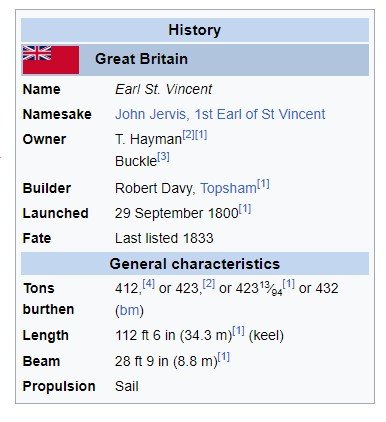
Earl St Vincent was built in Topsham, Devon in 1800. She made four voyages as a convict transport to Australia, the first three in 1818, 1820, 1823 to New South Wales. The final convict voyage was to Van Diemen’s Land (later Tasmania) in 1826.
 From 1818 to 1820 Earl St Vincent is listed in Lloyds Shipping Register with Samuel Simpson as master on voyages from London to Bombay. We have to assume these listings included the convict voyages above. In 1822 the ship underwent some large repairs and a change of ownership. In 1823/24 the ship is listed with owners Buckle & Co. and Peter Reeves as master for a third convict voyage from London to New South Wales. John William Buckle was a businessman, wine merchant, insurance broker and solicitor of Mark Lane, London. He was a partner in the ship-owning company Buckle & Co. with Thomas Henry Buckle (his brother), Henry Bagster and Walter Buchanan.
Another reference offered by Wikipedia, is T Hayman, a ship owner for whom I have found no information.
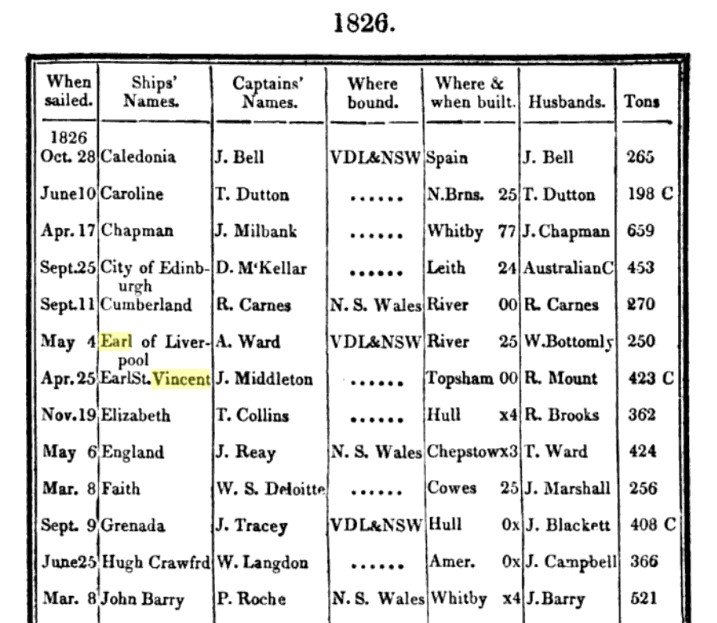
On 4th December 1824 the ship, under new master J Middleton and owner R Mount, left London for Batavia. The ship is listed in Lloyds in 1826 with the Middleton/Mount combination for the voyage to VDL and NSW. From 1827 to 1830 the ship is trading between London and Bombay. With the same captain and owner she is listed on voyages from London to St Petersburg until 1833. After that year her fate is unknown.
The Topsham-built ship is not to be confused with four other vessels of the same name which appear in Lloyd’s listings during the first half of the 19th century. They were built in the Isle of Wight 1798, Yarmouth 1798, Thames 1799, and in France 1803.
The Builder
Between 1800-1850 Robert Davy built a great many ships for the Royal Navy at his Topsham ship yards. If indeed the merchant and convict ship of 1826 was built by Robert Davy of Topsham, his son Francis said of him, in 1862,
At one period Robert Davy had ships building at one place and the other of various tonnage amounting on the whole to upwards of 1800 tons. He was so exact and prompt in completing his Government contracts within the time specified, that he never had any complaint, while many others were fined most heavily. But when the Government offered handsome premiums per day during the hottest part of the war, just prior to the close of it, about say 1812 to 1815, to all those who would complete their contracts prior to the time stated, he received very large sums in that shape having finished all his ships more or less before the time. The Admiralty offered him, as a mark of appreciation, several more ships to build, and sent men to survey the river to induce him to go on; but, in consequence of his health at this period (about 1815-16) getting rather indifferent together with his eyesight beginning to fail, he declined the offer [Willis:SNR 2021].
The Voyage
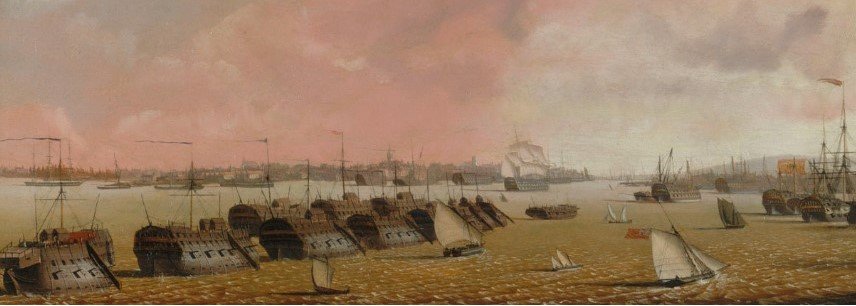
The voyage began at Deptford, sailing for Portsmouth on 1 Apr 1826. Upon arrival 160 male convicts embarked from two hulks sitting offshore at Portsmouth. Given the timeframe, they were probably HMS Racoon and HMS Leviathan [not verified]. The convicts had been tried and sentenced in courts all over England.
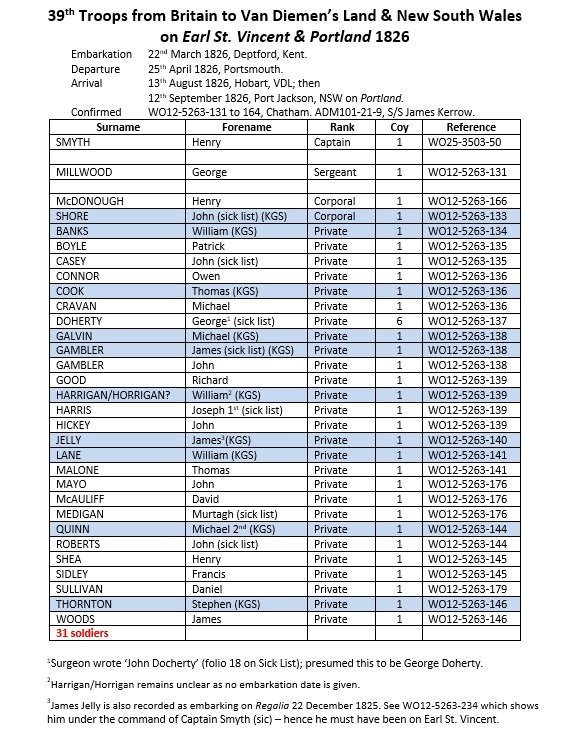
The 31 soldiers on board Earl St Vincent comprised Captain Henry Smyth, Sergeant George Millwood and 29 rank and file of the 39th Regiment. Corporal John Shore, Privates William Banks, Thomas Cook, William Harrigan, Michael Galvin, James Gambler, James Jelly, William Lane, Michael Quinn, and Stephen Thornton were all soldiers who later served in King George’s Sound. The ship set sail from Portsmouth on 25th April and did not put into any port on the journey before arriving in Hobart on 13th August 1826, a voyage of 110 days.
The Surgeon
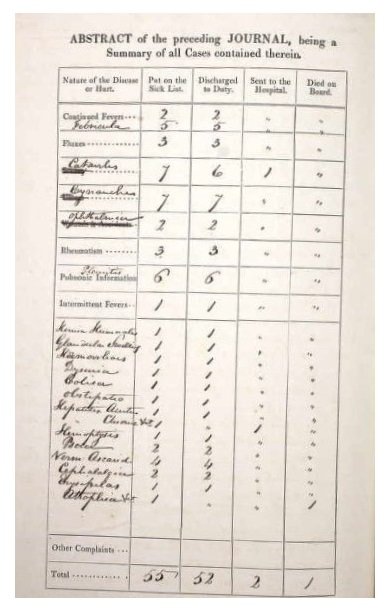 As was the custom, a Royal Navy Surgeon was on board. This was James McKerrow’s first voyage as a Surgeon Superintendent on a convict transport. Throughout the journey he would treat those who reported sick and keep a Journal of detailed notes on their medical cases, statistics of the type of illnesses on board, a list of his patients and even a meteorological report which included weather, thermometer and barometer records, together with latitude and longitude bearings from April to August 1826. His General Remarks are quite lengthy compared to other surgeons on other convict ships. He recorded that 55 passengers (convicts, crew and soldiers) reported in sick; 52 were treated and returned to duty; two were sent to the Colonial Hospital in Hobart.
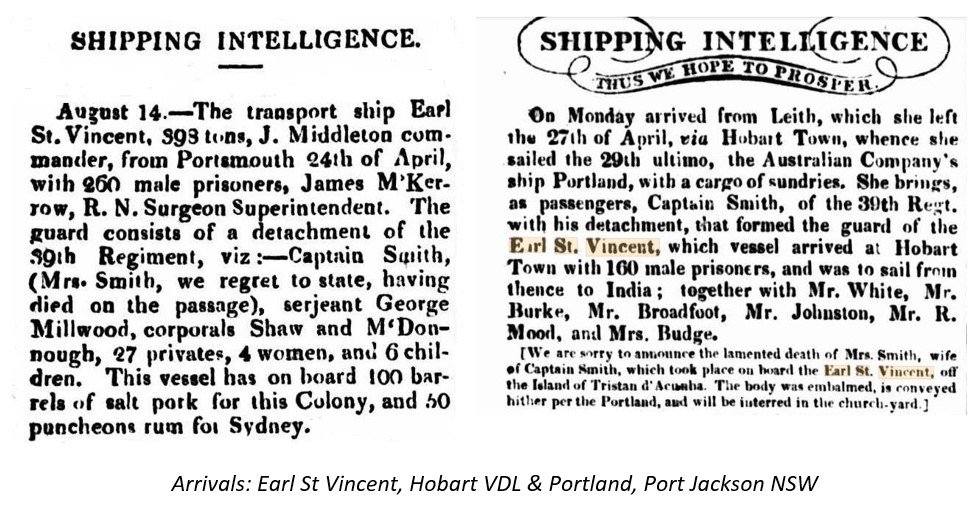
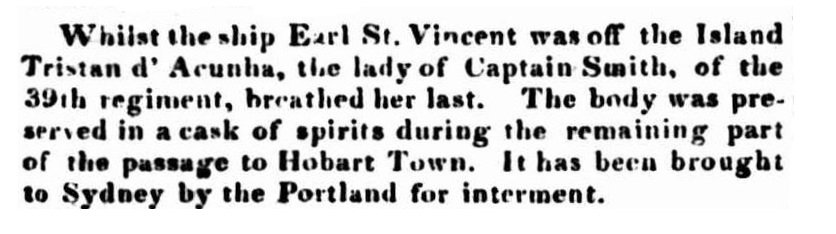 Undoubtedly soldiers on board would have been aware that their Captain’s wife (‘lady’) was sick for the entire journey. Mrs Smyth’s case notes take up several pages of McKerrow’s Journal and he was clearly very concerned about her from the outset of the voyage. He records (in part) after treating her for the entire journey, Mrs Smyth, aged about 35; Her symptoms were entirely induced by the ship’s motion operating on a constitution previously debilitated from long continued illness. Mrs Smyth for several years suffered much from sickness which her medical attendants on Shore termed ‘bilious’. Embarked with her husband who was officer of the Guard on board the Earl St Vincent in hopes that the voyage and change of climate might tend to renovate her impaired constitution, but it proved sadly the reverse. The ship’s motion was so very inimical to her stomach that everything swallowed was almost immediately rejected. Put on sick list, 25 April 1826. Died 25 June 1826. One newspaper report indicates Mrs Smyth’s body was embalmed, while another
 mentioned she was preserved in a cask of spirits. There were no other deaths on board but two convicts were hospitalised on arrival in Hobart.
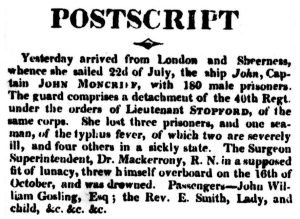
A postscript – about the Surgeon – later appears in a Sydney newspaper. His name is spelt incorrectly, but it is undoubtedly James McKerrow. His journal from Earl St Vincent suggests he was a kindly man who did not understand the nature of some of the men on board a convict ship. A second voyage on such a ship (John) may simply have proved too much for him. The Surgeon … in a supposed fit of lunacy, threw himself overboard … and was drowned.
Reconciling Embarkation Returns
The Embarkation Returns indicate that the ship Earl St Vincent was bound for NSW, when in fact she arrived and disembarked convicts and soldiers alike in Hobart Town on 13th August 1826; all other sources relating to this voyage also indicate the terminus being Hobart, VDL. Undoubtedly Captain Smyth had his own set of orders that included yet another journey for the 39th Regiment detachment. Three weeks after arriving in Hobart, the 39th set sail on Portland and disembarked at Port Jackson, NSW on 12 Sep 1826 as recorded on the Embarkation Returns.
Sources and Bibliography
Books, Journals and Websites
 Australian Medical Pioneers Index website.
Claim a Convict website.
East India Company Ships website, Andrea Cordani.
Free Settler or Felon website, Jen Willetts.
Lloyds Registers and Supplements of British and Foreign Shipping 1810 to 1835.
Ships of the East India Company, Rowan Hackman 2001.
Society of Nautical Research Forum (SNR) website, Sam Willis 2021.
Three Decks – Warships in the Age of Sail website, Cy Harrison.
Wikipedia and Wikipedia Commons.
Archives
Embarkation and Disembarkation Returns WO-3503-50, The National Archives, Kew.
Musters and Pay Lists WO12-5263-131 to 269, Chatham, The National Archives, Kew.
Surgeon Superintendent’s Journal ADM101-21-9, The National Archives, Kew.
Newspapers
Hobart Town Gazette 19 Aug 1826 – arrival in Hobart Earl St Vincent.
Sydney Gazette 13 Sep 1826 – arrival in Sydney Portland.
The Australian 13 Sep 1826 – Mrs Smith (sic) preserved in spirits.
The Monitor 15 Sep 1826 – Mrs Smith (sic) embalmed.
Sydney Gazette 16 Nov 1827 – death of Surgeon James McKerrow.
© Diane Oldman 2024