
DAVIS Robert Martin
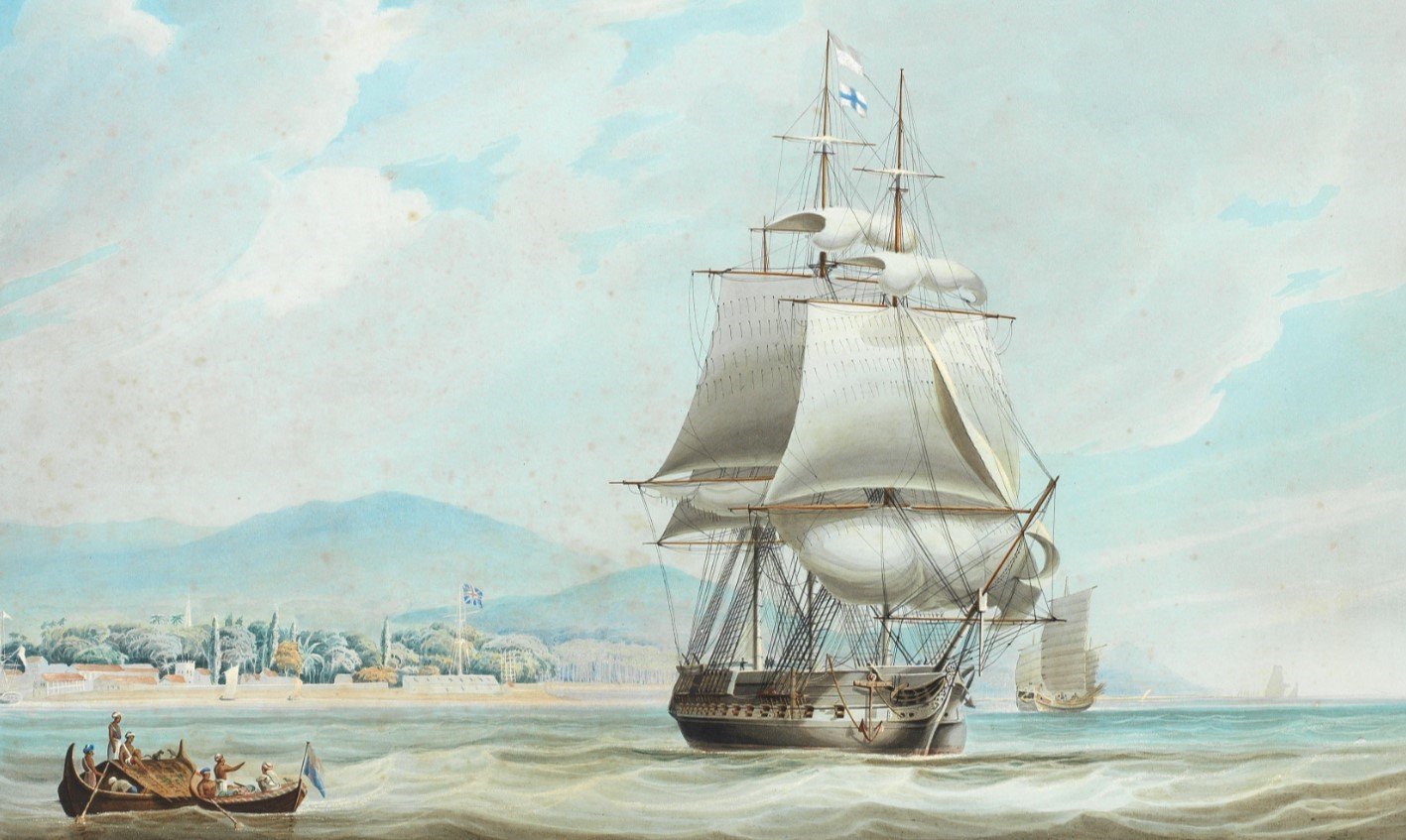
The Marquis of Huntly was a West Indiaman launched in 1804 in Aberdeen, Scotland. She was used as a transport ship by the British Government
carrying cargoes, troops and convicts. She made four voyages to Australia as a convict ship between 1826 and 1835 [Artist: William John Huggins]
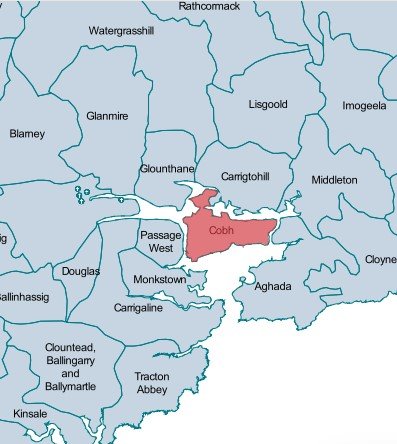
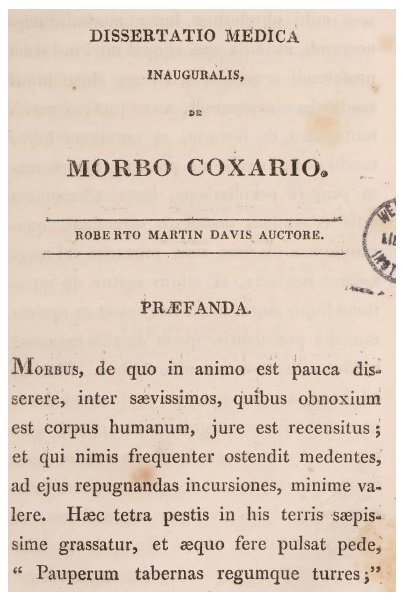
Robert Martin Davis was born in Cobh (Cove), County Cork, Ireland on 14th February 1798. At the age of 18, he graduated from Edinburgh University with his Dissertatio Medica Inauguralis, de Morbo Coxario [hip disease].
Davis may have continued his studies but nothing more is known of him until 1819 when he applied by letter, dated 10th August, for a position as Physician to the new Colony at the Cape of Good Hope. He wrote, I can produce the best authorities of my being regularly qualified both in Physic and Surgery, having received my education at the College in Edinburgh. I have two brothers who will break up their establishments to accompany me [CO48-42-684 TNA]. There is no indication that he was successful in this endeavour.
Joining the British Army
We next pick up a trail for the good doctor when he was appointed Hospital Assistant, 4th Regiment of Foot on 16th June 1825 [LonGaz:1195]. Five months later on 24th November 1825, Robert Davis joined the 39th Regiment as its Assistant Surgeon [WO25-732-317].
The Voyage to Australia
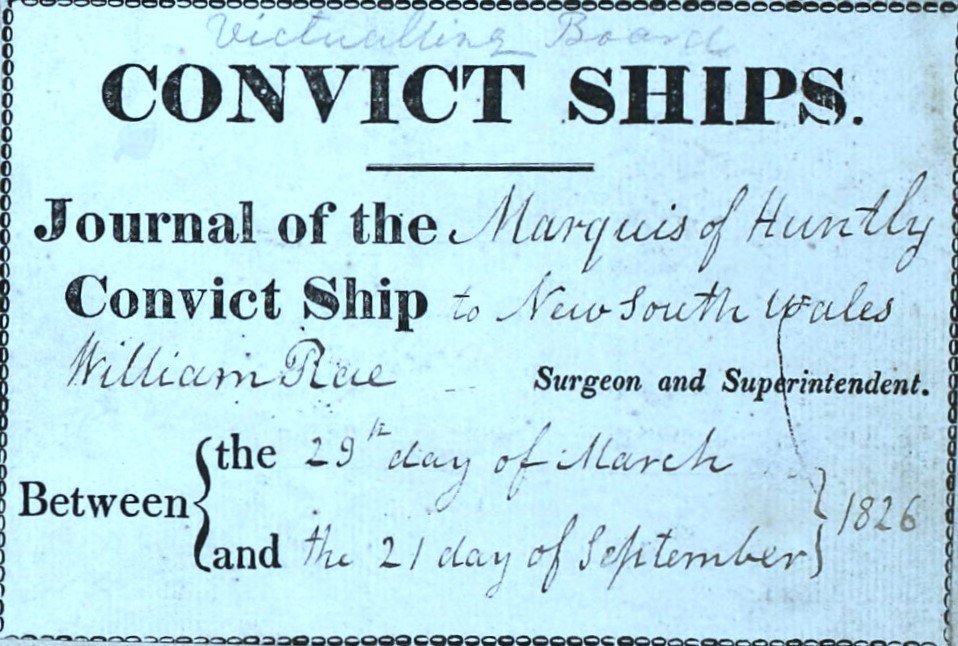 Davis was in Chatham at the beginning of April 1826 and from Deptford on the 26th embarked on Marquis of Huntly (Huntley) a convict ship bound for New South Wales accompanied by Major Donald McPherson, Lieutenant J Fitzgerald, two sergeants and 48 rank and file of the 39th Regiment. On the ship were Privates Patrick Garvey, John Higgins and John Hoop who would later serve at the Military Post in King George’s Sound.
Surgeon Superintendent William Rae joined the 564 ton convict ship on 29th April and would have examined the 198 male convicts who boarded the ship from prison hulks at Chatham. The ship left Sheerness on 16th May 1826 and arrived in Port Jackson, Sydney on 13th September 1826, a journey of 120 days. Master of the ship was Captain William Ascough.
The voyage was Superintendent Rae’s third of five convict voyages. He maintained a journal on board and recorded that 80 men had been on the sick list and 76 returned to duty; seven of these were soldiers of the 39th Regiment. There were four deaths among the convicts of typhus, diarrhoea, marasmus (malnutrition) and scorbutus (scurvy). Superintendent Rae generated an interesting map in the last pages of the journal, tracking the progress of the ship and showing the weather and illnesses experienced at different points during the voyage. One wonders if the two surgeons (Rae and Davis) got together to discuss the various medical cases, features of the journey or even the weather!
Military Expenditure NSW 1827-1828
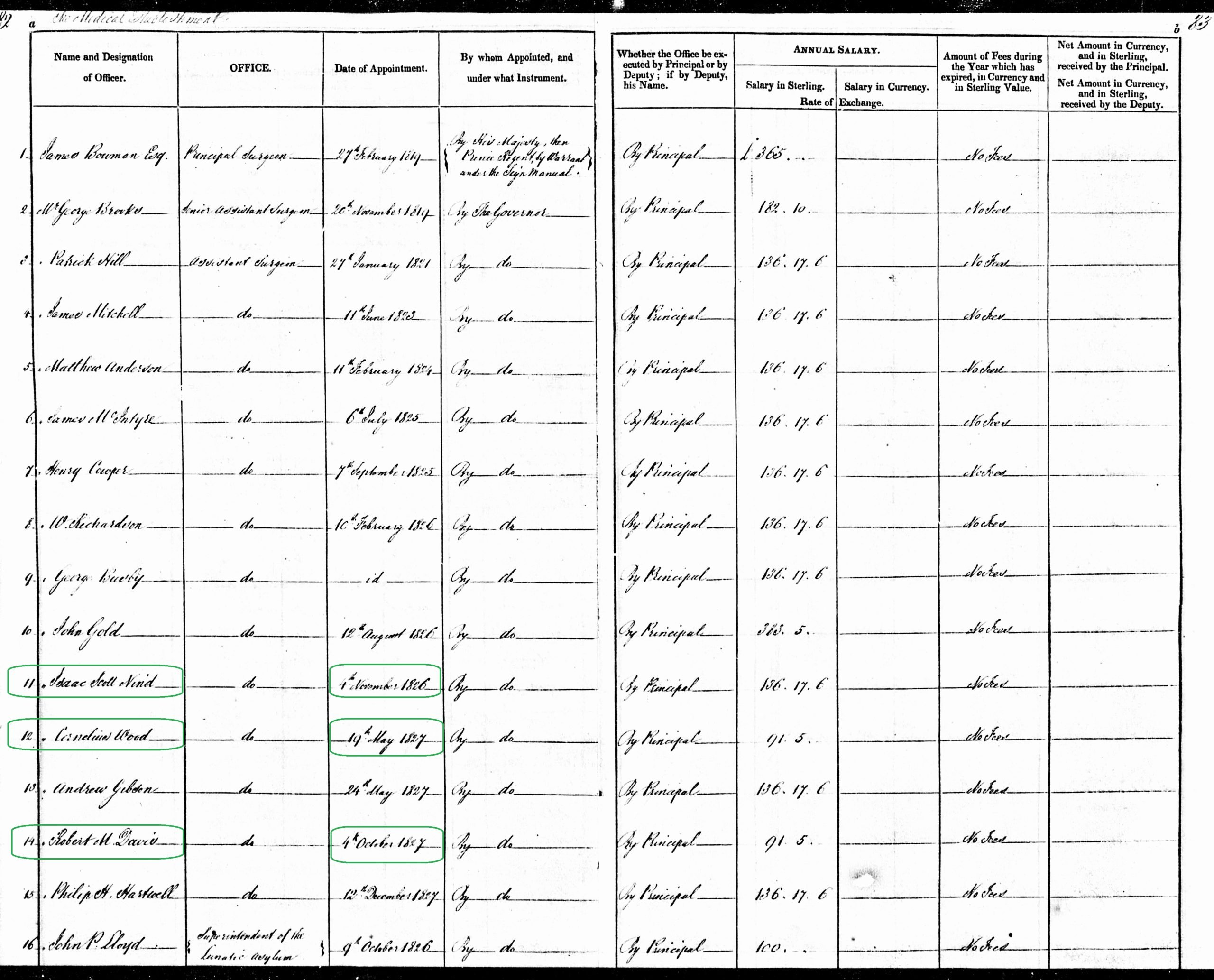
Payment to British Army (or Navy) officers in New South Wales appeared to be shared; military on a per diem basis and the Colonial government by annual salary. The 1827 NSW Colonial Secretary Returns (Military Expenditure) show thirteen officers of the 39th Regiment receiving per diem rates of pay for services to the NSW Colonial Government and where in the Colony employed. Robert M Davis, Assistant Surgeon is recorded at Windsor some distance from Sydney HQ [p. 31].
Davis was also recorded on the same return (Medical Establishment) with his appointment date by Governor Ralph Darling and annual salary of 91 pounds 5s. Others of interest to the Davis story are also listed among the thirteen Assistant Surgeons in the Colony [pp.82-83 right].
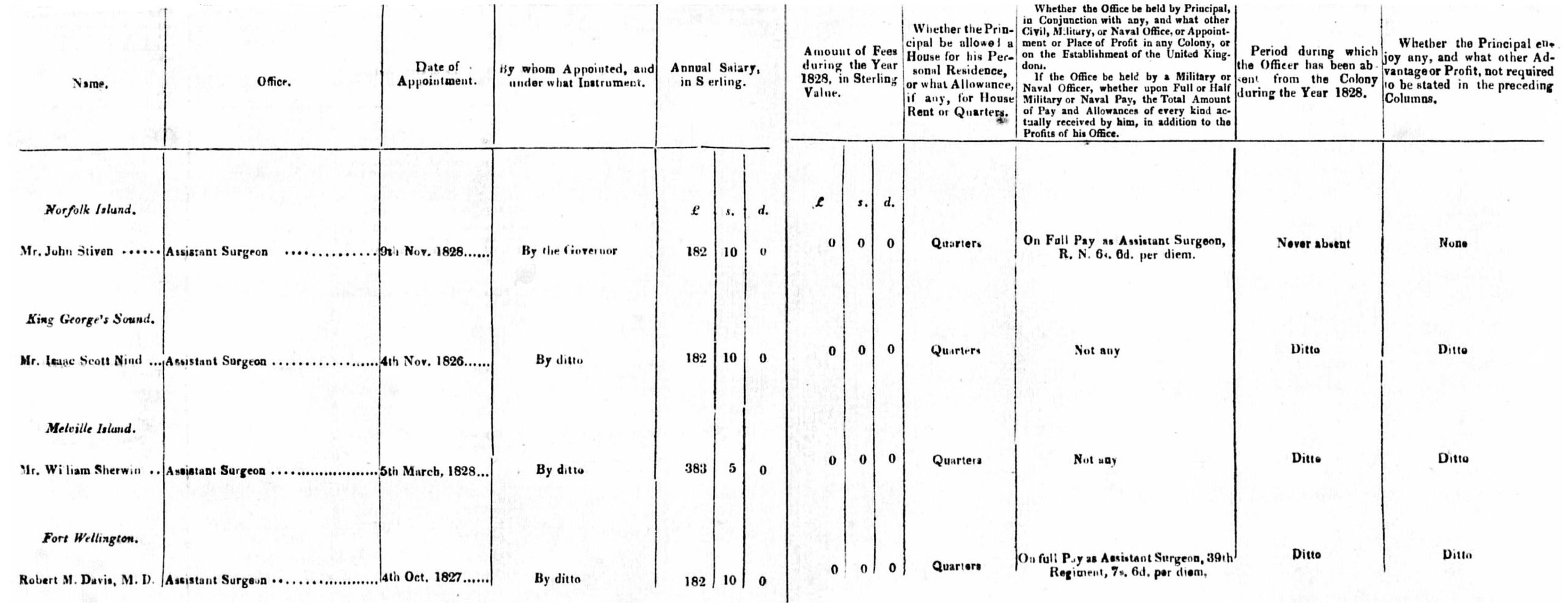
Davis’s first detachment of record in NSW was at the Civilian Hospital in Windsor in 1827 where he appears in the Colony’s same Medical Establishment annual returns. As Assistant Surgeon he was paid five shillings per diem by the Army. He was entitled to rations for himself and a servant (if the latter was not in the Army) plus 50 pounds per annum for quarters if Davis was not living in barracks [p 136]. The 1828 Returns (Medical Establishment) record Davis no longer at Windsor and now at Fort Wellington. The return below also indicates that some of the Assistant Surgeons at distant ‘northern coast’ settlements are civilians [p. 116].
‘Northern Coast’ Settlements at Raffles Bay and Melville Island
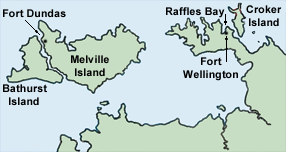 When Governor Ralph Darling arrived in NSW on 17th December 1825 via Hobart VDL, he was accompanied by soldiers of the 40th Regiment and the Royal Staff Corps, including a Royal Staff Officer, Assistant Surgeon Cornelius Wood. Dr Wood was appointed by the Governor to serve in the Colony on 19th May 1827. On 21st May he left with Captain Henry Smyth of 39th Regiment on Marquis of Lansdown on an expedition to start a settlement at Fort Wellington, Raffles Bay arriving on 19th June [HRA:767-69].
Captain Smyth became concerned from 25th September that Dr Wood’s health and mental stability were at risk when he contracted a continual fever and made an attempt on his own life. Wood died after many other upsetting incidents. After an enquiry was formed of a dozen men from the 39th Regiment and Royal Marines, and a further five people giving evidence on the day after his death, Captain Smyth determined that, He [Wood] died from ” Synocha ” or ” Simple continued Fever ” and ceased to exist at 9 o’clock P.M. 13th October, 1827, the 19th day from the commencement of the attack [HRA:780].
It would be some time before Cornelius Wood was replaced, and that coincided with Lieutenant George Sleeman arriving at Fort Wellington on 17th April 1828 to take up his position of Commandant at the Raffles Bay Settlement relieving Captain Smyth. Dr Robert Davis arrived on the ship Philip Dundas the day before Sleeman with a detachment of 39th Regiment troops, having sailed from Sydney on 16th March 1828. The Surgical instruments belonging to Surgeon Wood were transmitted [to Sydney] by Dr Davis [HRA:819].
LIEUTENANT SLEEMAN TO COLONIAL SECRETARY MACLEAY. 22 April (Despatch No. 1.)
Sir, Fort Wellington, Baffles Bay, 22nd April, 1828. I have the honor to acquaint you, for the information of His Excellency the Governor, that I arrived at this settlement in His Majesty’s Colonial brig, Governor Philip on Thursday the 17th Instant; and that I had the satisfaction of disembarking, on the following day, all the men who came with me in the possession of good health. The Philip Dundas, Marquis of Huntly, and the Denmark Hill accompanied us from Sydney to within a short distance of this place, at which the two first named vessels arrived the day before we did, when Doctor Davis and those of the Detachment, who came in the Dundas, landed in good health [HRA Series III, Vol. VI p. 793, Watson].
Dr Davis Arrives at Fort Wellington, Raffles Bay
Dr Davis arrived at Fort Wellington on 16th April 1828, where he would be in medical charge of not only the detachment of 39th soldiers, but several of the 67th and a party of Royal Marines [Wilson:72]. His first duty was to examine and write a medical certificate for the outgoing Commandant Henry Smyth. He and Dr William Sherwin, Assistant Surgeon at Melville Island (a civilian practioner) jointly signed the following on 18th April 1828: THIS is to Certify that we have carefully Examined Captain Henry Smyth of the 39th Regt. and have found that he has laboured under Scurvy and now suffers from Anasarca of his lower Extremities and prostration of appetite, apparently produced by too great bodily and mental exertion; and we do believe that his removal to Head Quarters will be essentially necessary for the Reestablishment of his Health, as this climate does not appear to us likely to effect that desirable Result [HRA:805].
The contents of Captain Smyth’s medical certificate were probably a kind version of a more serious situation at Fort Wellington which caused political reverberations in 39th HQ Sydney, the colonial government, and ‘at home’ in England. Smyth’s harsh treatment towards aboriginals in the first six months of his administration in 1827 seem to have been played down somewhat. Smyth had ordered grapeshot cannonade action on 30th July in response to native ‘pilfering’, and on 29th December ordered a punitive mission which included the killing of a woman and child in response to the injury of a 39th Regiment soldier.
Robert Davis remained at Fort Wellington at the Raffles Bay Settlement throughout the transition of Commandant from Lieutenant George Sleeman to Captain Collet Barker on 14th of September. Sleeman was transferred to the command at King George’s Sound effective 6th December 1828.
One of the few official mentions made of Davis during his time at Raffles Bay was made by Captain Barker in correspondence to Colonial Secretary Macleay on 26th February 1829: The Chief disease we have to contend with here is Scurvy. A great number of the men, both Military and Crown Prisoners, have shewn a tendency to it; and, but for a very liberal use of preventatives, many would, I believe, have been laid up by it. I have therefore made constant issues of Pickles, Prevention Mustard and Vinegar Weekly; and Doctor Davis, to whose unremitting attention we probably partly owe our health, has poured in Lime Juice and Nitre on the least appearance of the disease [HRA:825].
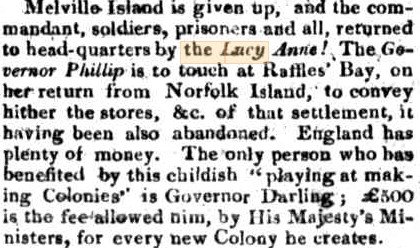
Davis would also have had first hand knowledge of the abandonment of Melville Island Settlement. Acting on the orders of the Secretary of State, Governor Darling sent the brig Lucy Anne from Sydney to remove the the stores, provisions, building materials and fruit trees at Melville island to Raffles Bay. The last of the three Commandants, Captain Humphrey Hartley, civilians, military personnel, and convicts, left Raffles Bay bound for Sydney, arriving in June 1829 [Wilson:128]. Little did Davis know that a similar fate awaited Raffles Bay Settlement and he would be part of its closure within the year. And again, little did he know, that for the second time, he would once more be relieving an Assistant Surgeon with mental health issues at King George’s Sound.
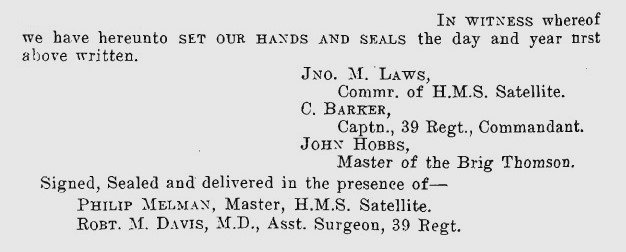 The decision to abandon the Raffles Bay Settlement was made in May 1829, but for various reasons – particularly the availability of ships – Collet Barker was not able to act until August. He chartered the brig Thomson and Robert Davis was one of the witnesses to the signing of the contract on 17th August 1829 [HRA:833].
Three ships were involved in the process of leaving Fort Wellington. Soldiers, civilians and convicts, animals and provisions, were all leaving the Raffles Bay Settlement in August 1829, but exactly who embarked on which ship is unknown except for the principal ‘players’ in this drama. Thomson accompanied by the brig Amity left on 24th August bound for the newly established Swan River Colony; Dr Robert Davis was on board Thomson. Governor Phillip sailed on 29th August for Koepang, Timor with Captain Collet Barker on board. With Barker was a Dr Wilson, who had tended to the placement of the tombstone of the late Dr Cornelius Wood in those last days of the settlement. Barker had mentioned a Dr Wilson in his correspondence to HQ Sydney, without explanation of the man’s appearance at the settlement. Thomson, with Dr Davis on board made it to the Swan River Colony on 19th September, Amity three days later, and Governor Phillip on 17th October 1829. Most of the 39th Regiment rank and file would sail on to Sydney but some would stay in the West for duty at King George’s Sound.
There are a host of stories and debates relating to the Melville Island and Raffles Bay Settlements which have been written of in both official documents and other publications. This is not the place for these.
Flashback… A Tale of Two Surgeons

Dr Robert Davis had been in Fort Wellington, Raffles Bay around five months, when 200 male convicts boarded the convict ship Governor Ready in Cork, Ireland, under the watchful eye of a detachment of guards from the 63rd Regiment. The ship sailed on 21st September 1828 arriving in Sydney on 16th January 1829. It was Surgeon Superintendent Thomas Braidwood Wilson’s second voyage on Governor Ready and the fifth voyage of his nine voyages to Australia all told. On this occasion Governor Ready, after delivering the prisoners, was bound for Batavia en route to England. However, she was wrecked on 18th May 1829 in the Torres Straits. Three vessels from the ship were rescued: a skiff, jolly boat and long boat, whereon the 39 crew were distributed. Ultimately it was Mr Radford in charge of the Commissariat at Raffles Bay (and a friend of Dr Wilson’s) on board the ‘busy little brig Amity’ who rescued the crew after 14 days at sea: Radford had been on his way back to Fort Wellington from Koepang with provisions for the settlement.
It was under these circumstances that Dr Thomas Braidwood Wilson met Dr Robert Martin Davis. In Wilson’s book, ‘A Voyage Round the World’ he wrote a great deal about Davis, and much of what occurred in the dying days of the Raffles Bay Settlement. His book contains many details about the relationship between Commandant Collet Barker and the natives. It is enlightening and very readable. One account relating to Davis was quite amusing. As the narrative was also accompanied by a sketch, both are here:
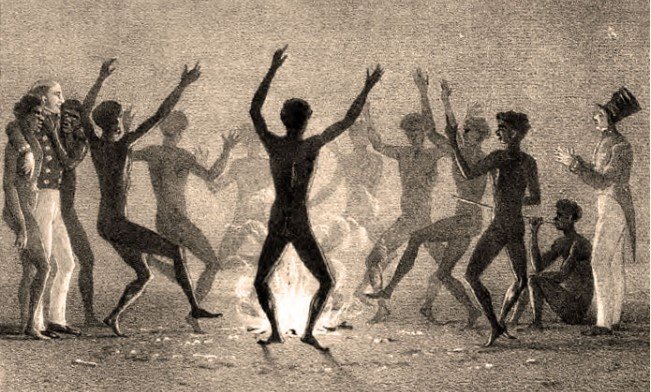
In the evening [31st July 1829], a large fire was kindled just before the fort, and the natives danced round it with great vigour and spirit, to the music, produced by one of their party from a long hollow tube. Dr Davis joined them, but although he might “keep time” correctly enough for a civilized ball-room, yet he fell short in that necessary part, at least to a savage ear; so they, in very polite terms, requested that he would not fatigue himself, but stand and look at them. Lieutenant Weston, of the East India Company’s service, took a very spirited and correct sketch of this singular performance [Wilson:87-88].
King George’s Sound
Three ships left Raffles Bay in August 1829 and all would rendezvous at the Swan River Colony where Captain James Stirling, the first Swan River immigrants, and a detachment of the 63rd Regiment had arrived at the new Colony less than three months previously. Dr Robert Davis arrived on Thomson from Raffles Bay on 19/20th September and on 29th, embarked on Amity for King George’s Sound, arriving on 4th October 1829. Arriving with him on Amity were a number of 39th Regiment troops from Raffles Bay who relieved others bound for Sydney on the Amity‘s return journey. Also on board Amity was Mr John Kent, from the NSW Commissariat Department who had recently arrived at Raffles Bay from Sydney. He was to become the fourth King George’s Sound Commissariat Storekeeper.
There is little mention of Dr Davis in official correspondence and most of it relates to joint recommendations about convict health between ‘Doctor’ Davis and ‘Mr’ Nind [HRA:544-546]. The distinction in titles being that Davis was a doctor, while Nind was a licenced apothecary; both, it should be noted, were appointed as 39th Regiment ‘Assistant Surgeons’ .
In mid-1828 Commandant Joseph Wakefield and Mr Isaac Scott Nind had requested to be relieved of duty at KGS, but only Wakefield was accommodated in December 1828 when he was relieved by Lieutenant George Sleeman. Nind was told in March 1829, in consequence of the exigences of the public Service, his request to be relieved could not at present be complied with [HRA:525]. Davis would have needed all the tact he could muster collaborating on soldier and prisoner health issues, as Mr Isaac Scott Nind had been in a state of mental depression and unpredictability for some time before Davis arrived to replace him. Nind finally left The Sound on Amity in October 1829.

Dr Thomas Braidwood Wilson left KGS 20 Sep 1829 bound for Tasmania on Governor Phillip. He then sailed to Sydney where he took passage to England on the ship Surry on 9 Apr 1830, thus leaving depriving us of a very good source about Dr Davis’s activities.
Following James Stirling’s appointment by King George the Fourth as Commander in Chief of Western Australia (4th March 1831), he [Stirling] appointed Alexander Collie as Government Resident at King George’s Sound and arranged for the 63rd Regiment to relieve the 39th troops. Twenty one troops, two women and four children, including Captain Collet Barker left on 27th March for Sydney on the government schooner Isabella. Dr Robert Davis, Mr John Kent, Storekeeper, other civilians and prisoners of the Crown.
I would like to be able to say that Dr Davis was witness to the death of Captain Collet Barker – but of course no one was – except his killer or killers, if indeed he was murdered. His body was never recovered; the circumstances of his death related verbally and written, by too many people, too soon or too late after the fact to be verified. For example, For a certain reward, one of the men agreed to accompany Mr. Kent to the main with a native woman, to communicate with the tribe that was supposed to have killed him. They landed at or near the rocky point of Encounter Bay, where they were joined by two other natives, one of whom was blind. The woman was sent forward for intelligence, and on her return gave the following details… [Sturt]. Barker’s body was never found, cause of death more rumour than fact.
From this point we can find Robert Davis located in New South Wales, Norfolk Island, back to New South Wales and finally India. The Pay Lists were completed by Pay Masters in Sydney, Chatham and Bangalore; on some occasions in more than one place in the same period. I am certain the War Office was able to untangle these records and ensure Dr Davis was remunerated correctly; we researchers are often bewildered, but we try.
Norfolk Island
After about six weeks in HQ Sydney, Dr Davis at last took a month’s leave in July 1831. One can imagine how he luxuriated in the life of Sydney after his isolation in KGS. But all good things come to an end and on 3rd August 1831 he returned to duty at HQ and the following month on 19th September embarked for Norfolk Island [WO12-5266-32/99]. By the time Davis arrived, James Morisset had been Commandant for over two years and the convict population was over 550 and rising. It was a tough assignment for both the convicts and administrators and probably more so for an assistant surgeon.
India
Six companies of the regiment embarked at Sydney on the 21st July 1832, in three divisions, and disembarked at Madras on 22nd September, 10th and 14th October. The remaining four companies embarked at Sydney on 3rd December and arrived at Madras on 21st February the following year. Davis, having returned to Sydney from Norfolk Island by mid-October 1832, was with the second embarkation leaving for India on 3rd December. He is recorded as being in Poonamalee on 22nd February 1833 [WO12-5266-259]. On 15th April 1833 Davis, along with the other later arrivals, joined the regiment at Bangalore under the command of Major Thomas Poole [Cannon:73].
Madras Quarterly Medical Journal Contributions
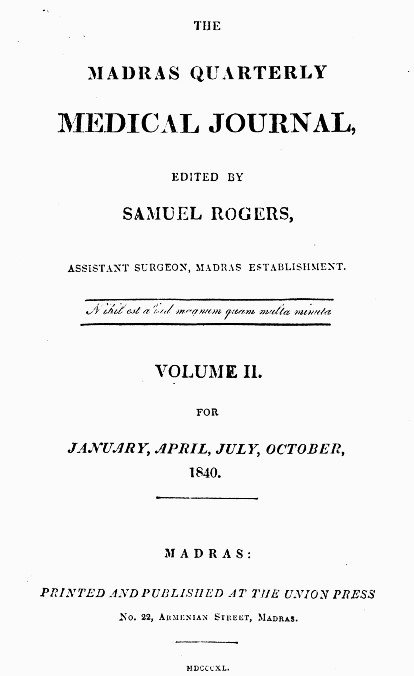 Dr Davis is lost to me between his arrival in Bangalore in 1833 until 1837 when he became a contributor of the Madras Quarterly Medical Journal Volume Two, 1840, and we find his reports for 1837 and 1838 posthumously published.
We can see that two of the officers whom Davis treated would have been known to him: Captain [George] Sleeman was afflicted with Cutaneous eruptions depending on a deranged state of the Gastric and Intestinal Secretions, and connected also with Nephritis Calculosa. Captain [John Long] Innes after having suffered from Hepatitis since his arrival in the Country in 1832, contracted violent disease of the right Tibia, which ended in our being obliged to amputate his leg below the knee. The operation was successful [MQM Journal:398].
This is the reality of cholera’s impact on the regiment in India – three months in March to May 1839 – a tribute to its doctor who worked tirelessly amongst its sufferers and paid the price:
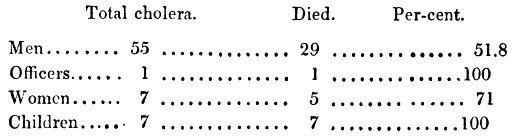
Now it will be confessed by all who witnessed the exertions of Dr Davis in hospital, that no one could have been more unremitting, or enthusiastically ardent in his attention; while nothing could have surpassed the frequency and regularity with which the remedies were administered ; and yet we can boast of no greater success than what appears above! [MQM Journal:100].
Death and Obituary
The regiment was halted there [Adoni] until the 21st [September 1839], during the greater part of which time it rained heavily, but the men were very healthy. On the 27th it reached Coodamoor, where the whole force was assembled, consisting, in addition to the Thirty-ninth, of two squadrons of the Thirteenth light dragoons, the Seventh regiment of Native cavalry, the Third, Sixteenth, Thirty-fourth, Thirty-ninth, and Fifty-first regiments of Native infantry. The head-quarters of the Sappers and Miners, a troop of horse and two companies of foot artillery, with four eighteen-pounders, four twelve-pounders, several mortars, howitzers, and a large and well equipped park. A formidable resistance was, therefore, expected by the Government; and subsequent inquiries proved that the intended antagonist was supplied with most numerous and well constructed implements of destruction, and that a part of his force consisted of brave and determined soldiers.
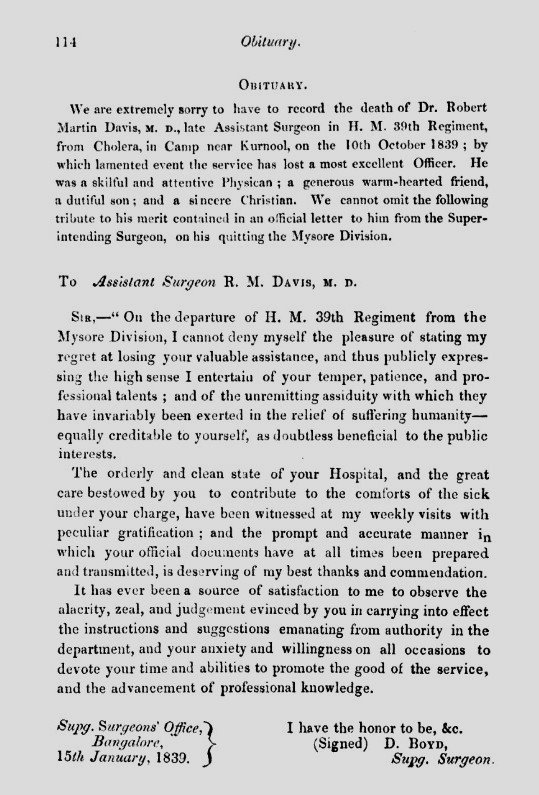
At Coodamoor the regiment remained halted for many days; and on the 1st of October the cholera unfortunately broke out, and lasted with considerable violence for about ten days, during which time Lieut. Samuel Philips, Assistant Surgeon Robert Martin Davis, M.D., of the Thirty-ninth regiment (a most valuable and excellent medical officer), and six men died therefrom [Cannon:83].
Robert Martin Davis died of cholera on the 10th October 1839, aged 41, near Coodamoor, Presidency of Madras (now Kodumuru, Kurnool District, Andhra Pradesh), India.
Will and Probate
As is often the case, Robert Martin Davis’s Will is a treasure trove of names of family: mother, uncle, brother, sister, nieces, cousins, friends, army comrades, etc. The handwriting (not Davis’s) is difficult to transcribe but is linked here. It was a Prerogative Court of Canterbury (PCC) Will written on 9th May 1839 and proved at London with Codicil on 3rd November 1841. It was also indexed in the Prerogative Wills of Ireland in 1848 – presumably because of Robert’s property (a dwelling house in Cobh, Cork) left to his mother.
Sources and Bibliography
Books, Journals and Websites
Edinburgh University Graduates in Medicine from MDCCV. to MDCCCLXVI website.
Historical Records of Australia (HRA) Series III, Volume VI Tasmania, Western Australia and Northern Territory by Frederick Watson 1923.
Historical Record of the Thirty Ninth Regiment or the Dorsetshire Regiment of Foot, Richard Cannon Esq., 1853 [Project Gutenberg].
Madras Quarterly Medical Journal, Ed. Samuel Rogers, Madras Establishment. Vol. 2, pp. 382-403, 114. Union Press, 1840.
Roberto Martin Davis Dissertatio Medica [Edinburgh University 1816], Internet Archive.
The Settler Handbook by M.D. Nash 1987.
South Africa, Passenger Index, 1688-1950, ancestry.com online index.
South Africa, City and Area Directories, 1813-1962, ancestry.com online index.
Two Expeditions into the Interior of Southern Australia Vol. ii, p. 239, Captain Charles Sturt, Public Domain – Project Gutenberg Australia.
A Voyage Round the World, T B Wilson MD, RN, 1835. Public Domain – Project Gutenberg Australia or Google Books.
Archives
Admiralty Superintendent Surgeon’s Journal ADM101-50-7, National Archives, Kew.
Australian Almancks January 1829 and 1830 – 39th Regiment Officers, NSW Archives.
British Army Lists & Commission Registers 1661-1826, National Archives, Kew.
Prerogative Court of Canterbury, Last Will and Testament, PR11-1953-283, National Archives, Kew.
Prerogative Wills Index 1811-1858, Public Record Office, Ireland.
Returns of the Colony (Blue Books) 1827-1830 Military and Medical Establishment, NSW Archives (MHNSW).
War and Colonial Department and Colonial Office: Cape of Good Hope Colony (Cape Colony), CO48/42, 684, National Archives, Kew.
War Office Musters & Pay Lists WO12-5263 to WO12-5266, National Archives, Kew.
War Office Statement of Services WO25-732-317, National Archives, Kew.
Newspapers and Gazettes
The London Gazette 9 Jul 1825, ed.18153, p. 1195- Davis appointed Hospital Assistant.
The Australian 16 Sep 1826 – arrival Countess of Huntly.
Sydney Monitor 20 Jun 1829 – Melville Island abandoned.
Sydney Monitor 21 May 1831 – Isabella KGS arrival Sydney with 39th Regiment.
South Australian Register 30 Apr 1885, p.6 – Captain Collet Barker [death].
Register 22 Jan 1903, p.5 – ‘How Captain Barker Disappeared’, Dr Davis’s Official Report.
Illustrations
Marquis of Huntly convict ship, by William John Huggins.
Parish of Cobh, RC Diocese of Cloyne, County Cork, National Library of Ireland.
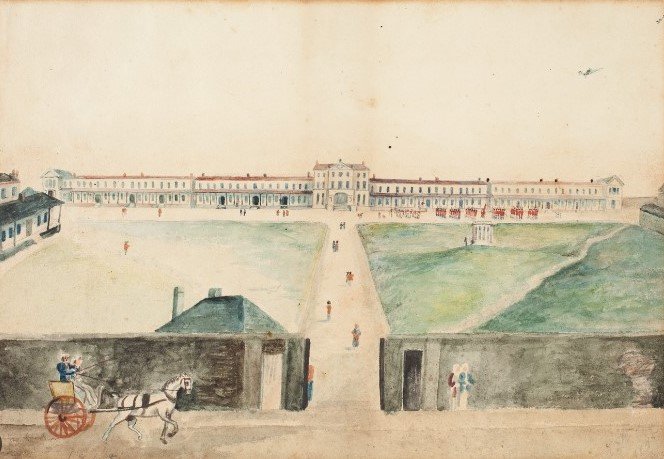
Wynyard Army Barracks 1792-1848, by George Roberts.
Cobourg Peninsula, Wikipedia.
Dance of the Aborigines of Raffles Bay, by Lieutenant Weston, E.I.C.
Thomas Braidwood Wilson, Wikipedia (unknown artist).
© Diane Oldman 2024