
Regalia 1826

No, this is not a Sunderland shipyard. In my endeavour to find an image of a 19th century shipbuilding yard. I found this image,
generated by 21st century AI (artificial intelligence). Fanciful isn’t it?
The Ship
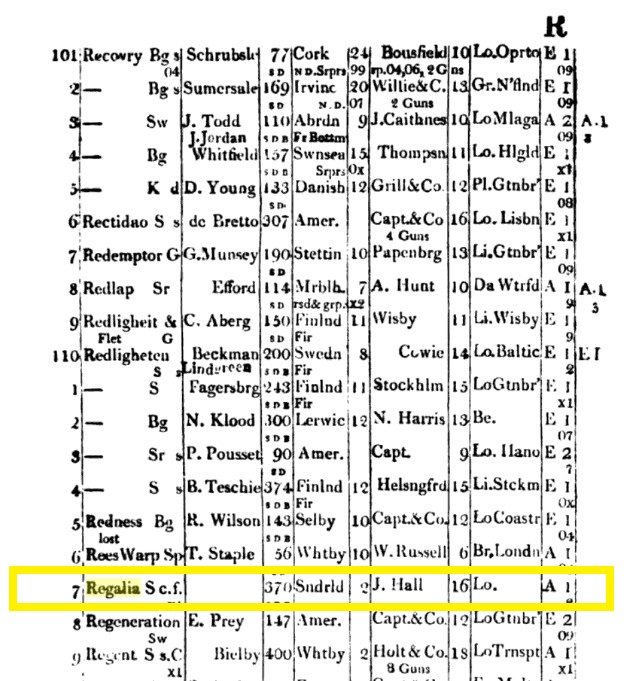
Regalia was a 370 ton, copper-fastened ship, with a single deck with beams and a draft of 16 feet, launched on 28th December 1811. She had been built in one of the many yards in Monkwearmouth, Sunderland on the north side of the mouth of the River Wear. In March 1814 there were 23 yards at Sunderland, with 31 ships under construction. By 1815, it was the leading shipbuilding port for wood trading vessels. That year, 31 yards built around 600 ships. Regalia was surveyed in February 1811 and registered in London as an A1 first class vessel with first class quality materials. Nothing is known of her builder. Her owner was probably J. Hall, about which nothing is known at this time either.
The 1811-built ship is not to be confused with an immigrant ship to Quebec and trader to the West Indies of the same name, built in Whitby in 1813 (owner Oldfield); nor another built in Sunderland in 1828.
Career pre-Convict Voyage
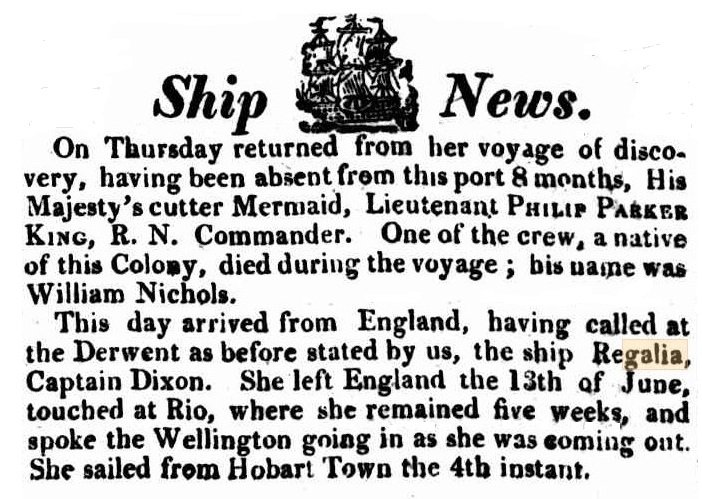
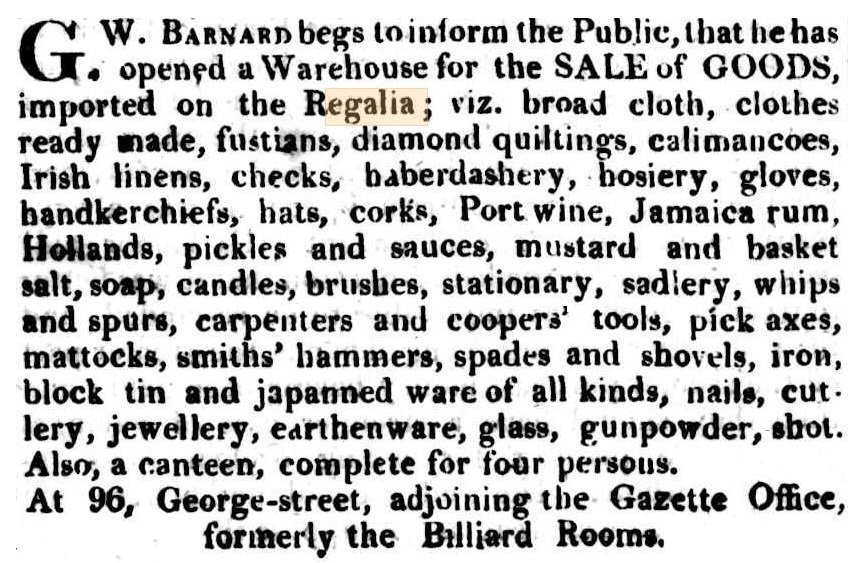
Regalia was a busy ship and had a high turnover of captains and owners. She began her career as a coastal trader out of London. In June 1819, after the East India Company began licensing other ships to sail its routes to India, Regalia sailed to Calcutta (then identified as Fort William) with Francis Dixon as captain and G Welbank the owner. It appears that on this same trip she arrived in Hobart, Van Diemen’s Land (Tasmania) on 1st November with merchandise and passengers. She was in Sydney by mid-January 1820 as many of the newspaper advertisements for her cargo show – auctions and warehouse sales continued throughout February.
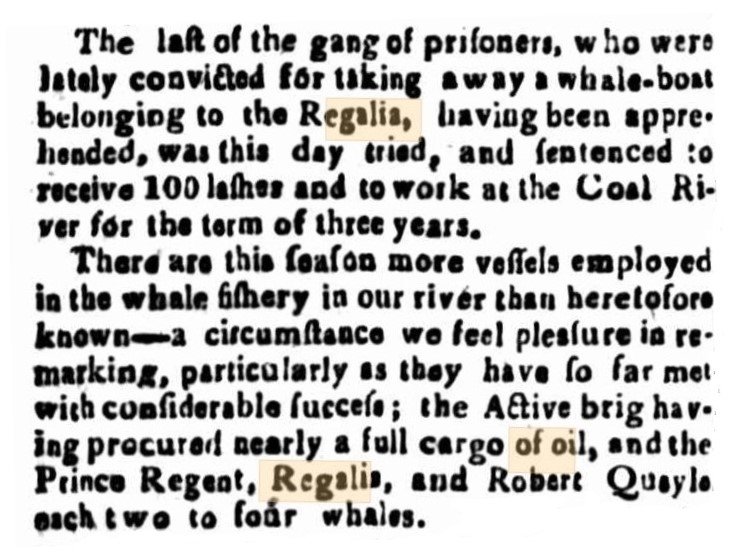
On 12 May 1820 Regalia arrived in Hobart with passengers Mr John Raine and his wife who had been with the ship since leaving England exactly 11 months before; John Raine was brother of Captain Thomas Raine of the convict ship Surry, a frequent visitor to Australia’s shores. I would suggest that John Raine may have had an investment in Regalia, if not entire ownership, since she was about to engage in a whaling and seal hunting venture. Despite the theft of her whale boat, Regalia managed to haul in a few whales that season, while the thieves were sentenced to 100 lashes and three years hard labour. If the successful whaling season were not enough, Mrs Raine delivered a daughter on 23rd June – it is not clear whether she was on board Regalia at the time! The whaling and sealing around Macquarie Island continued into 1821 until Captain Dixon sailed Regalia from Sydney back to England on 15th August.
On 22nd May 1822 the ship is recorded as sailing from London to Bombay and by 7th August she was on her way to VDL and NSW, on this occasion with Captain T Collins, and now owned by William Grey/Gray.
The Surgeon and the Lieutenant
James Rutherford was appointed Royal Navy Surgeon in 1803. He received his MD at Edinburgh University in 1814, his dissertation on De Febre Flava (Yellow Fever); he became a Member of the Royal College of Surgeons in 1822. He and his brother George S Rutherford were well respected men in NSW Colonial circles.
The Regalia voyage was Surgeon Superintendent James Rutherford’s first experience on a convict ship. He would make three more voyages: Pyramus 1832, Mangles 1833 and Hooghly 1834. The number of convicts for whom he was responsible over his four voyages was 717; the total number of deaths only five. This is an amazing record considering that in the early 1830s there were several cholera epidemics in England and many cases on board convict ships. On Mangles there was only one fatality – at Sheerness before leaving British waters – a victim of cholera. Rutherford is on record for having nursed a further 18 cholera patients back to health on the journey to Australia. The Sydney Gazette newspaper remarked (in part), on the arrival of Mangles in April 1833, The whole of the prisoners who have arrived by that vessel, are in the most perfect state of health, which says much for the judicious treatment of the parties under whose management they have been placed.
It is uncommon for the Superintendent Surgeon’s Journal to be missing from the documents relating to a convict ship voyage, but not entirely unheard of. I have not been able to uncover the reason for Rutherford’s missing Admiralty Medical Journal; I doubt the fault was his. He certainly was onboard throughout the entire journey and arrived in Sydney on board Regalia. He maintained good records of his patients in subsequent voyages. What is strange is that a search for other documents relating to this voyage are also missing, including the Home Office Transportation Register of convicts for Regalia AND the Prison Hulk Register of prisoners for the hulk Essex. It is indeed a blessing that the Lieutenant wrote of the Regalia voyage in his ‘1827 Newcastle Notebook and Letters’, so ably presented and extended with well researched historical context by Cynthia Hunter in 1997 – 100 years after his death (see sources below).
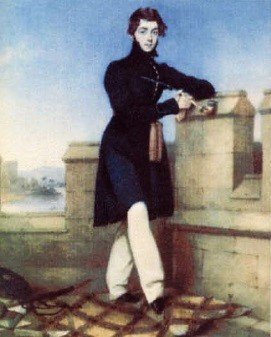
Lieutenant William Sacheverell Coke was born in 1805. He entered The Royal Military College (later Academy), Sandhurst at the age of 14 in the Junior Department. On the 8th January 1824 he entered the Army as an Ensign with the 39th Regiment, first stationed in Limerick, Ireland; he became Lieutenant on 1st August 1825 by purchase. The following year he was in command of 29 men from his regiment who would act as convict guards on Regalia. It was Coke who remarked, Rutherford was a ‘gaunt and worn-out doctor of the Navy’ and could hardly have been in a convict ship from other than necessity [Hunter:14]. While the two men started off with a fractious relationship on board, they called a truce mainly because of their common dislike and problems with Captain Robert Burt, master of Regalia. It was Robert Burt’s only voyage as master of a convict ship. Coke resigned his commission in the Army in August 1829 after he had taken 12 months’ leave. After a full and eventful life with two marriages and many children, he died aged 90 on his family’s estate at Brookhill Hall, Pinxton, Derbyshire.
Now let us return to the ship, the soldiers and…
The Voyage
The soldiers and their Lieutenant left the Chatham Depot for Deptford in typical winter weather and embarked on Regalia four days before Christmas. The ship encountered problems in the Thames almost immediately – a bad omen for what was to come on this voyage. The pilot ran the ship aground near Blackwall, encountering two other ships into the bargain. Then a change of wind left them stuck in the Thames for a time. They finally left England’s shores for a stormy passage to Kingston where the convicts would be boarded from the hulk Essex. Essex had been a distinguished American 32-gun frigate built in Salem, Massachusetts in 1799 for the burgeoning American navy. She was captured and taken to Plymouth in 1814. Ten years later she was moved to Kingston, Dublin and used as a convict hulk to accommodate up to 300 prisoners. The hulk was sold at public auction in 1837. Lieutenant William S Coke attended the examination of 129 Irish male prisoners awaiting transportation. This would be his first encounter with Dr Rutherford. More bad weather stymied their journey from Dublin but eventually an 18-pounder cannonade was fired from Regalia, the signal for the pilot to take her out of Kingston Harbour in mid-March. Regalia passed Madeira at the end of the month and reached San Antonio on 5th April. The next stop for provisioning was Rio de Janeiro where they dropped anchor on 17th May and left on the 24th. It would be their last stop before reaching Port Jackson, Sydney on 5th August 1826.
Regalia did not return to England until 20th December 1826.
The Unwilling Passengers
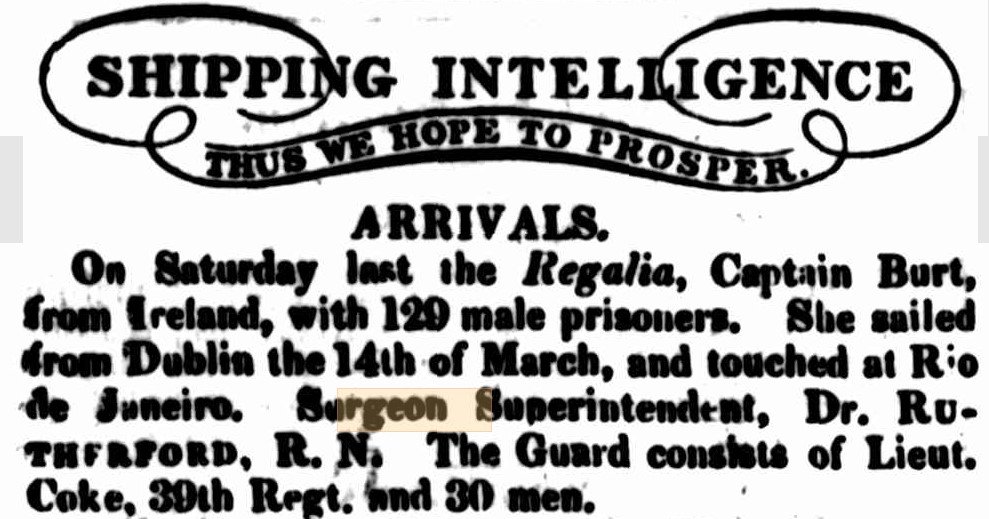
During 1826 a total of 16 ships arrived in NSW and VDL with convicts on board. On eleven occasions detachments of the 39th Regiment were on board these convict ships as guards. Various sources have reported 130, 129 or 128 convicts leaving Ireland and/or arriving in NSW on Regalia. Without the benefit of the hulk register or surgeon’s journal from which to reconcile the totals, I will go with 129 boarded and 129 disembarked.
The average sentence of those on board was 21 years with 20 convicts out of the total receiving life sentences. Over 45% of the convicts were tried and sentenced in Dublin, the remainder from various other counties in Ireland.
After arrival, the convicts were inspected by Colonial Secretary Alexander McLeay on 8th August. They were then disembarked after a passage of 142 days and inspected on shore by Governor Ralph Darling on the following day.
The Convict Guards
The 39th Regiment guards embarked on Regalia at Deptford on the Thames on 22nd December 1825 and via Dublin sailed for NSW with Lieutenant Coke, one sergeant and 28 rank and file. In less than a year of boarding Regalia, six of the rank and file would board the brig Amity and serve at a military post in King George’s Sound. They were as follows: Privates Patrick Boyle, John Denn (Dunn), William Hill, Thomas Horstins, Maurice Mullins, and John Sweeney.
The Ship’s Demise
After Regalia’s return to England she is on record as trading from London to St Kitts in the Caribbean with Captain Addison and owner William Grey. From 1828 she underwent small repairs and her classification was downgraded to E1 (second class) and listed with Captain W Sadler and J Row, owner, trading from London to Quebec.
 In 1831 after some larger repairs, and undoubtedly design changes, Regalia returned to whaling for the northern whale fishery trade. She is recorded with Captain Phillips and owner Mellish. From 1831 to 1835 she was based in London, whaling out of Greenland in the Davis Strait. Her best year during that time was 1833 when she fished 26 whales and 240 ‘tuns’ of whale oil. In 1835 the Coltish Tables (see sources) has listed her under ‘Scotland’ which is the year she changed home port registry to Kirkaldy. In 1835 and 1836 she is listed with Captain Phillips, but in 1837 to 1840 with Captain Elder. She is not listed in Coltish beyond 1840. In 1841 I found Regalia in Lloyds Register listed with Kirkaldy as her registration port but working out of Leith to Davis Strait with Captain R Kerr, owner Dugall & Co. She had a short stint of working from Leith to Dalhousie and Quebec, Canada during 1842 to 1846.
In 1847 she had another change of captain to D Robb but continued to be owned by Dugall & Co., and after some further repairs went back to work in Davis Strait until 1851 – her last complete listing – and somewhere along the way with more repairs she regained a partially improved classification to AE1.
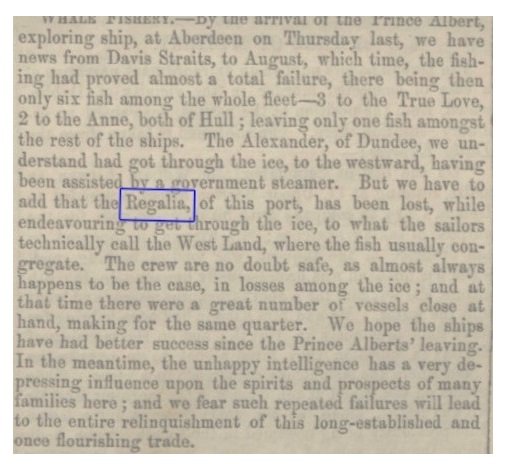
On 20th June 1852 Regalia was crushed by ice in Davis Strait. The incident was not reported until October in the British newspapers. It seems that there were plenty of ships in the area to rescue the crew, whom it is said, got drunk and set fire to the ship! She didn’t deserve such a fate after spending forty years plying the roughest oceans in the most extremes of weather.
Sources and Bibliography
Books, Journals & Websites
The 1827 Newcastle Notebook and Letters of Lieutenant William S. Coke, H.M. 39th Regiment, Cynthia Hunter, 1997.
An account of the success of the ships at the Greenland and Davis Straits fisheries 1772-1842 inclusive’, William Coltish Tables (in spreadsheet format].
Australian Medical Pioneers website.
Dún Laoghaire-Rathdown County Council website.
Free Settler or Felon, Jen Willetts website.
Lloyds Registers and Supplements of British and Foreign Shipping 1811 to 1852.
Shipbuilding on the Wear Fact Sheet No. 10, Local Studies Centre, Sunderland City Council.
Wikipedia and Wikipedia Commons websites.
Archives
Embarkation and Disembarkation Returns WO-3503-50, The National Archives, Kew.
Admiralty 101 Medical Registers and Journals 1798 to 1856, The National Archives, Kew (Regalia missing).
Home Office Prison Hulk Registers HO 9, The National Archives, Kew (Essex missing).
Home Office Transportation Registers HO11, The National Archives, Kew (Regalia missing).
Musters and Pay Lists WO12-5263-97 to 130, Chatham, The National Archives, Kew.
Newspapers & Gazettes
London Gazettes 1824 and 1825 – Coke’s Army commissions.
Sydney Gazette 15 & 29 Jan 1820 – Regalia arrival, auctions.
Sydney Gazette 26 Feb 1820 – Regalia warehouse sales.
Hobart Town Gazette 13 May 1820 – Regalia whaling voyage.
Hobart Town Gazette 10 Jun 1820 – Regalia whale boat theft.
Hobart Town Gazette 24 Jun 1820 – Birth of Mr & Mrs Raine’s daughter.
Sydney Gazette 9 Aug 2026 – Regalia arrival Sydney.
Sydney Monitor 11 Aug 2026 – Regalia arrival Sydney.
Sydney Gazette 30 Apr 1833 – Mangles voyage prisoners’ health.
Fife Herald, Cuper 14 Oct 1852 – Regalia lost on ice.
Hull Packet 21 Jan 1853 – replacement ship for Regalia.
Derby Mercury 11th Mar 1896 – Obituary W S Coke of Brookhill Hall, Pinxton.
Illustrations
A 19th Century Shipyard generated by artificial intelligence (so I don’t need to attribute it!).
Davis Strait Map, Wikipedia.
Portrait of William S. Coke c. 1822 in Sandhurst undress uniform of 39th Regiment, artist unknown (original with Coke Family). Front cover of Hunter publication 1997.
© Diane Oldman 2024